Postcards from Below
Five artists, one headset, and the Malta nobody sends home - at the Gwangju Biennale
“These are places tourists don’t go.
Places most Maltese don’t think about. And that was the point.”
Look Malta up online. Go on… you know what you’ll get. Blue water, honey-coloured stone, a sunset over the bastions, a beach that’s somehow smaller than in the photo. One of the smallest nations in the world – and we sell ourselves like a postcard.
Then there’s the Baroque. Glorious, yes – but everyone writes about the Baroque. I won’t.
What I want to talk about is the other thing. The thing the brochures leave out.
Malta’s contemporary art scene is extraordinary. I say that as someone who has spent years collecting it, living with it, chasing it into studios and garages and half-finished buildings – and I say it without hesitation. We have artists here doing work that is sharp, brave, strange, urgent… and almost nobody outside the island knows.
Part of that is size. Being small is charming on a postcard. In practice it’s a kind of oppression – a ceiling you keep hitting. Small market, small audience, small budgets, a world that assumes an island this size can’t possibly have that much to say. So the work stays local. It gets made, shown for three weeks, and folded away.
But here’s the thing about a small place with a very long, very intense history – invaded, ruled, bombed, converted, rebuilt, sold – it doesn’t produce small art. All that pressure has to come out somewhere. It comes out in our contemporary artists. And making it visible – getting it seen beyond our own shores – has become, quite simply, my mission.
Which is why what I found in a basement in Gwangju mattered so much to me.
Down the stairs
This year Malta had its first-ever presence at the Gwangju Biennale – and what a debut! Upstairs, Norbert Francis Attard’s installations hit hard – political, unflinching, speaking about Gaza at a moment when too many prefer silence. PONKS built a poetry temple – words given a place to be entered, not just read. Serious work, and work I deeply respect.
But the pavilion had another heart, and you had to go looking for it.
Down the stairs. Into the basement. Into a small dark room – and then one more step, the one most visitors didn’t take… putting on the headset.
Inside were postcards. Postcards from Malta – and a few from Korea too, but it’s the Maltese ones I’m writing about. PORTAL is a single work conceptualised and directed by PONKS with seven invited artists, developed as part of the public programme BEJN / IN-BETWEEN, the Malta Pavilion at the 16th Gwangju Biennale, commissioned by Arts Council Malta.
Not the postcard you know. No Blue Grotto. No Popeye Village. Instead – a garage. A freeport. A bombed-out chapel. The National Library after hours. A landscape you’d only find if someone who loves it took you there.
These are places tourists don’t go.
Places most Maltese don’t think about. And that was the point.
I know these artists – personally, some for years. I’ve followed their work, sat in their openings, argued with them over late drinks. And standing in a dark basement thousands of kilometres from home, headset on, seeing my island through their eyes… I’ll admit it – it got to me.
Why VR, I ask?
A word on the medium, because I think it’s exactly why this room was underestimated.
VR asks something of you. Time. Curiosity. A willingness to look slightly ridiculous in public with a plastic box strapped to your face. Plenty of people won’t – they glance at the door, see the queue or the dark, and keep walking.
Their loss.
Because once you’re in, there’s no frame. No wall label at a polite distance. No safe spot from which to observe. You turn your head and the world turns with you – above, behind, under your feet. You’re not looking at the work… you’re standing inside it. In a performance piece, that changes everything. The body in front of you isn’t an image. It’s company.
For artists working through the body, through site, through memory – VR isn’t a gimmick. It’s the closest thing to taking someone by the hand and saying come, I’ll show you.
“From the beginning, we wanted the technology to feel intuitive and unobtrusive, particularly for visitors who may have little or no previous experience with VR,” said Mark Anthony Sammut (Infinita). “We therefore developed the experience around natural hand interaction, removing the need for physical VR controllers and allowing visitors to simply use their hands to interact with the experience.”
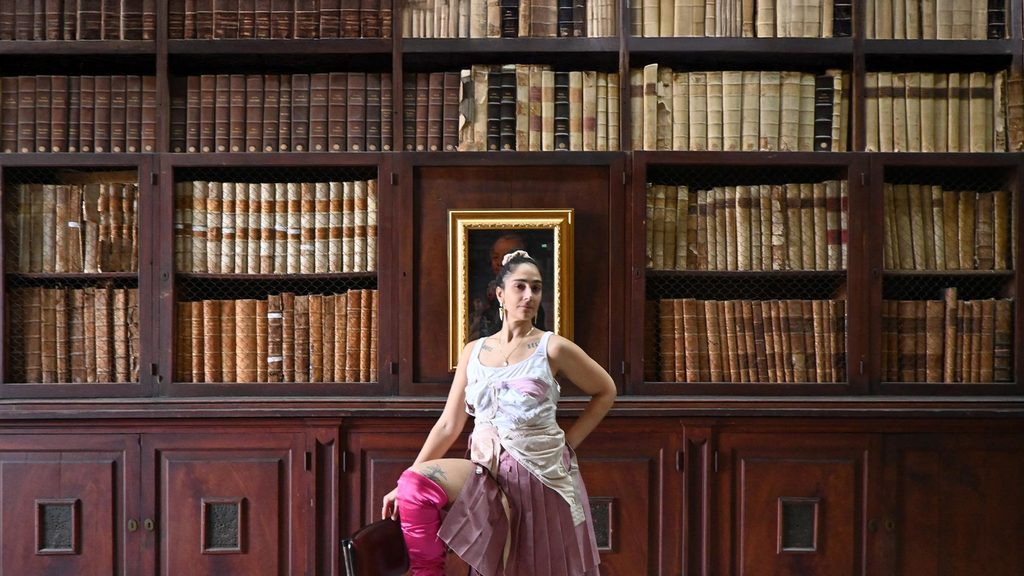
Charlene Galea – Standard Procedure
First, the National Library. Valletta. All that marble authority, all those archives – written, catalogued, classified and governed almost entirely by men. A building that decided, for centuries, whose words counted.
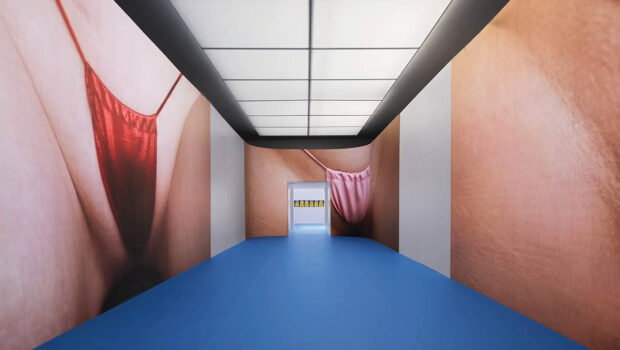
Into this walks Charlene… in a costume made of bras.
Donated bras, charity-shop underwear, lace, domestic fabric – every garment designed to support, shape and regulate the female body – stitched together into one dense, layered, heavy shell. Seams exposed. Joins visible. Nothing smoothed or hidden. It’s armour and it’s a cage at the same time – an understructure turned inside out, an archive of other women’s intimacy, wear and use.
For most of the performance it holds. Heavy. Contained. And her poem plays – teasingly, relentlessly – with the letter F. Every F-word you can think of… and a few you probably can’t… spoken inside the one building where women’s words were least welcome.
Then, near the end, the structure loosens. Pieces begin to fall.
It’s quietly devastating. Charlene’s body becomes the unwritten history – all the stories that never made it onto those shelves. And the question underneath it is simple: whose bodies, whose voices, get to leave a trace in official memory?
In VR, you’re in the reading room with her. You can’t look away from the shelves… or from her.
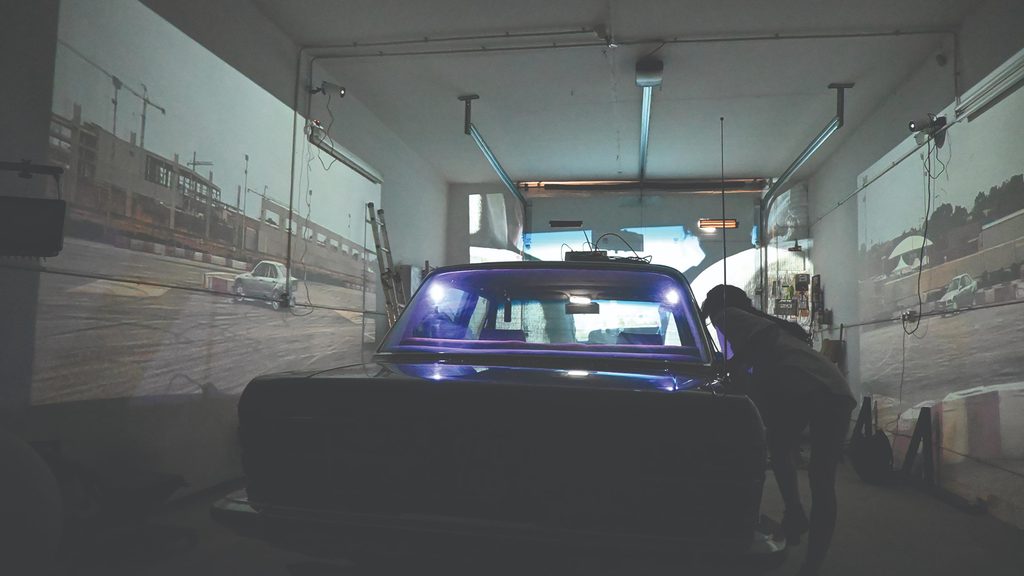
Image courtesy of PONKS.
Martina Georgina — DAD 001
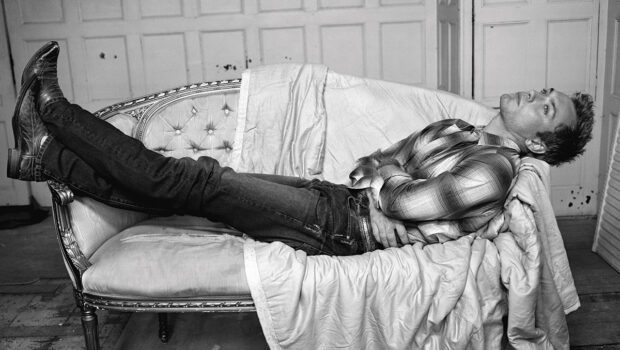
A garage. A Fiat 130 – her grandfather’s, then her father’s, polished to a mirror and believed to be the only one left on the island. The number plate says it all: DAD 001.
Martina circles the car the way she grew up circling her father’s world – from the outside. Never quite in. She shifts between roles – guest, intruder, heir, observer – negotiating where her body can be, where her voice is allowed. The car is desire, power, projection… a whole emotional language that men in her life spoke to machines rather than to each other.
On the garage walls, a recording of a drive she once took with her father in that same car. Alongside it, her own archive footage of Ħal Far – the drag races, the drifting, the smoke and the noise – a Maltese masculinity expressed through speed, risk and rebellion. A world her father introduced her to.
Then – the cut.
Stillness becomes speed, and suddenly you’re inside a drifting car. In a headset, that moment hits the body before the brain catches up. The intimacy of the garage ruptures – and that’s the point. What do you do with the version of masculinity you inherit… when you find yourself drawn to another one entirely?
It’s tender and it’s loud. Very Maltese, in both directions.
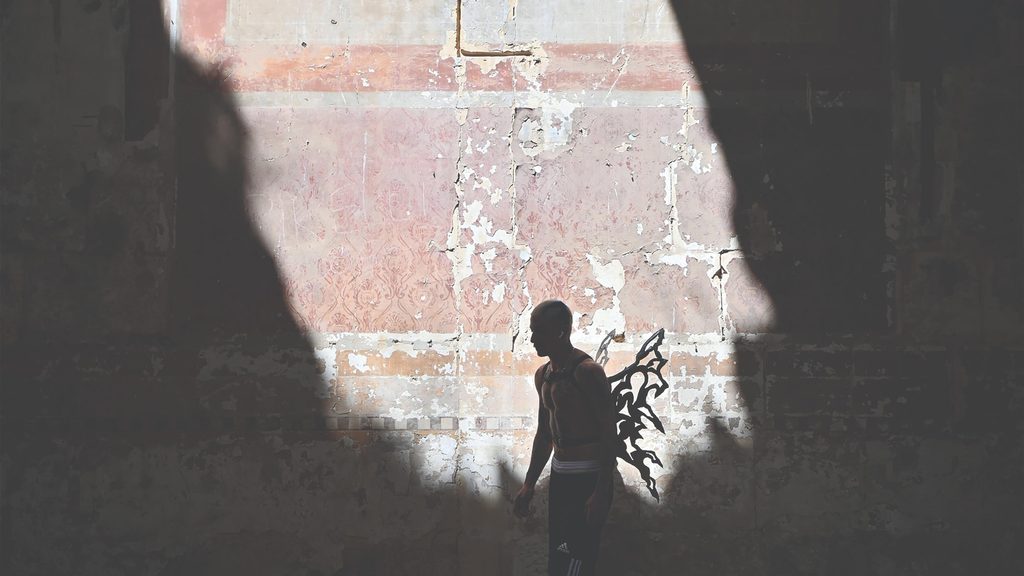
Romeo Roxman Gatt – Elevani (Elevate Me)
The Saviour Gate Chapel in Kalkara. Bombed during the Second World War. Abandoned ever since. Now hemmed in by cranes and fresh concrete as Kalkara is polished, developed and sold – one more neighbourhood shaped by construction, real estate and overtourism.
Romeo hangs there.
Angel. Demon. Topless priest. He moves between characters – guided, and interrupted, by the will of the trans gods. Suspended on a metal pole and pull-up structure, beneath a hole in the ceiling where the light pours in. Vulnerable. Open. Seen.
Anyone who knows Romeo’s work knows it’s usually physical – carrying bricks, pushing, force, even aggression. Behaviours coded as masculine, taken on deliberately. This is different. Not exertion – endurance. Stillness. Just hanging, vertical… holding on until he can’t anymore.
Around him, billboards. Protest slogans dressed in the bright, confident grammar of global advertising – “Right wings are everywhere, but not in my church.” Wings, angels, religious symbols, digital elements built with 3D artist Costas Kazantzis – all set to industrial textures and distant church bells sliding into strings, drum machines, trance.
It’s a ruin full of futures. At a time when borders are tightening and trans rights are under threat almost everywhere, Romeo uses the wreckage – of a church, of capitalism, of certainty – as a place to imagine something else. Not tidy progress. A refusal. A walking away from what’s already collapsing.
Of all the postcards, this is the one I’d most like to post to certain people.
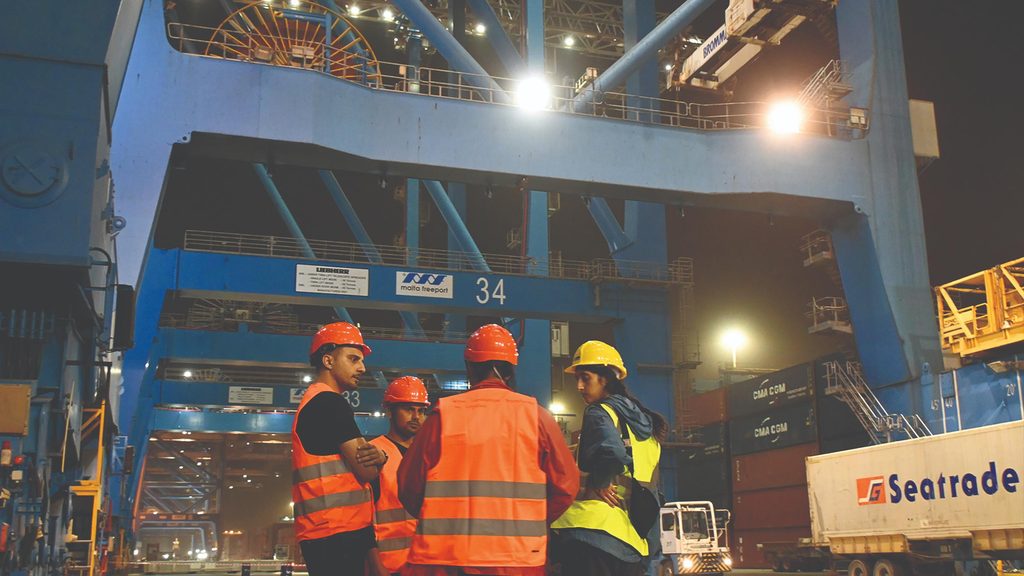
Filmed at Malta Freeport. Image courtesy of PONKS.
Keit Bonnici – Psychokinetic Economies – mill-baħħ għal idi
The Malta Freeport. Almost everything you eat, wear and plug in on this island arrived here – floated across the sea in anonymous steel boxes. The photographer and writer Allan Sekula called the sea “the forgotten space.” The port is where the forgotten space docks.
Keit brings three port workers into the yard – Marilyn Latayan, Anvesh Dunna and Salvatore Grixti, each from a different department – among the cranes and carriers that move containers in their endless, flattening, machine choreography. Logistics as ballet, with no dancers.
And then he gives the workers psychic powers.
They conjure psychokinesis. Human bodies against mammoth machinery. Will against abstraction. It’s playful and strange – and underneath, quietly furious. Because behind every box there’s a chain of hands nobody sees, a transnational history of labour and capital, hidden by design.
Standing in the yard in 360°, the scale is overwhelming. You feel how small a person is there. Which makes the gesture – three workers, raising their hands against all that steel – feel enormous. The work leaves you with the questions the supply chain is built to make us forget: from where? how? who? to whom?
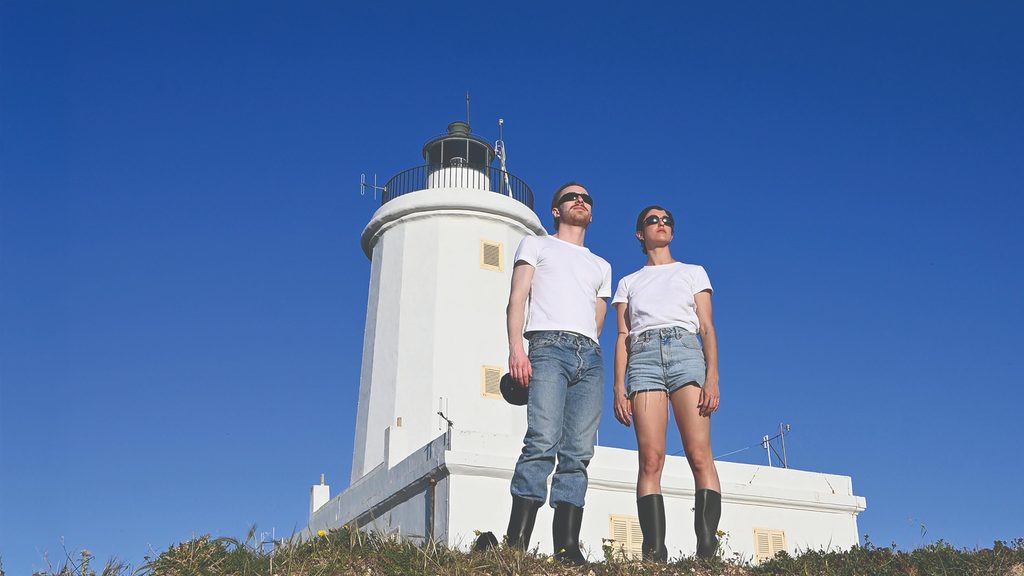
Tara & Felix – Two Birds and a Stone
And then… breath.
Two contemporary dancers in the Maltese landscape – not using it as a backdrop, but feeling it, carrying it, remembering it. They wander, repeat, respond. A gesture starts as a reaction to a texture, a distance, a rhythm – and through repetition becomes something lighter. A fragment. A trace. A bit of childhood… running, weaving, gathering.
The work begins with a question that hit me hard, standing in Korea: what happens when a place is remembered rather than lived in?
This is the piece that uses VR most generously. You choose where to look. You choose who to follow. You’re far from Malta – and yet placed inside it – bringing your own memories into the encounter. And the landscape itself feels like an archive – layered, old, and fragile. What looks permanent is disappearing. You feel it.
It’s a love letter, really. To the bits of the island that are still beautiful… while they still are.
What we choose to send
Five postcards, then. None of them pretty in the brochure sense. All of them honest.
And here’s what stayed with me on the flight home. When Maltese contemporary artists are handed the job of representing Malta to the world – this is what they choose. A library that excluded women. A garage full of inherited masculinity. A bombed chapel drowning in development. A port built on invisible labour. A landscape slipping away.
That’s not an attack on the island. It’s love – the kind that tells the truth. It’s also a mirror. Looking at what our artists decide to show tells us something about who we are right now – what hurts, what’s at stake, what we’re about to lose.
That’s why this work can’t stay in a basement in Gwangju.
If I have one regret, it’s where these works lived – underground, in the dark, behind a headset. A vital part of the pavilion, and an easy one to miss. Plenty did. So, I’m pushing -lobbying, frankly – for the VR works to be shown back home, where Maltese audiences can take the time to put the headset on and see themselves through their own artists’ eyes.
We’re small. We’ll always be small. But our artists aren’t… and it’s long past time they were seen.
Bring it upstairs. Bring it home.
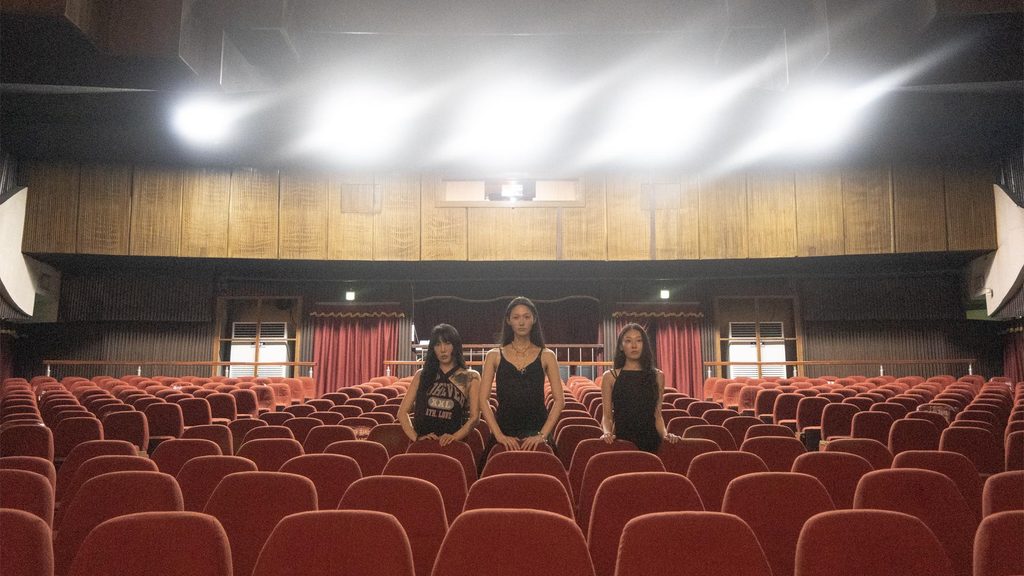
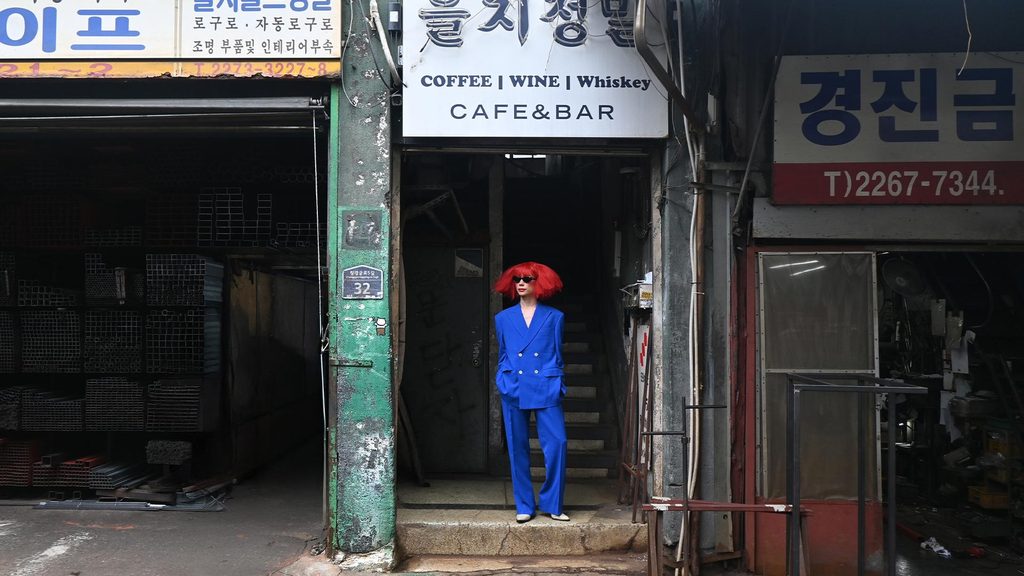
The 16th Gwangju Biennale, You Must Change Your Life, takes place from 5 September to 15 November 2026 in Gwangju, South Korea, with artistic direction by Ho Tzu Nyen; the Malta Pavilion, BEJN / IN-BETWEEN, is presented at Horanggasy, featuring artists Norbert Francis Attard, PONKS (Sam Alekksandra and Julien Vinet), and Michael Quinton, curated by Moon Hyun Jeoung, with Toni Attard as project manager and Yeoul Son as Malta–Korea liaison, and commissioned by Arts Council Malta with the support of the Ministry for Arts, Culture and the National Heritage, the Ministry for Foreign and European Affairs, and the Cultural Diplomacy Fund.
PORTAL, conceptualised and directed by PONKS with seven invited artists, is presented in the Trans/portation room of the Malta Pavilion at the 16th Gwangju Biennale, BEJN / In-Between. Conceived as a portal between Malta and Korea, it brings together seven 360-degree videos, five filmed in Malta and two in Korea, viewed on VR headsets. Together they form one bridge rather than separate pieces, resting on the idea that contemporary art and poetry are the same process: a need to react to what surrounds us. The Korean videos are Euljiro Lady by MORE (Euljiro 4, Seoul) and Cry on Cue: Performance in Cinema Gwangju by KIMON (Cinema Gwangju, Gwangju).
Concept and direction by PONKS. Invited artists: Charlene Galea, Romeo Roxman Gatt, Tara Dalli & Felix Deepen, Keit Bonnici, Martina Georgina (Malta); MORE, KIMON (Korea). VR programme developed by Infinita. Public programme supported by the Cultural Diplomacy Fund, managed by the Ministry for Foreign and European Affairs.
PORTAL will be on display from 29 October (from 6pm) until 29 November at Valletta Contemporary as part of The Earth will Swallow and Swallow.