Allegoria
What happens to an artwork when time begins to undo it?
Through three contemporary interventions in three majestic churches, Allegoria explores the fragile relationship between conservation, memory, power and the changing nature of the sacred.
Every act of preservation begins with an acknowledgement of loss. To conserve a work of art is to confront the destructive nature of time, to intervene at the point where matter begins to surrender to entropy. Yet restoration can never return an object to an untouched past. It can only negotiate with the traces that history has left behind. What is removed, what is retained and what is made visible are never entirely neutral decisions.
It is within this paradox that Allegoria, an interdisciplinary project emerging from RECOOP’s conservation practice, takes shape. Bringing together artists Clint Calleja, Austin Camilleri and Pierre Portelli, the project draws upon three restored works of sacred heritage: a Baroque crucifix from the Parish Church of the Annunciation of the Virgin in Tarxien, Domenico Guidi’s sepulchral monument to Grand Master Nicolas Cotoner in the Chapel of the Langue of Aragon, Catalunya and Navarre at St John’s Co-Cathedral in Valletta, and Mattia Preti’s Madonna Portiuncola at the Church of St Francis in Valletta. Each has been marked by the material consequences of time, from oxidation and biological deterioration to the accumulation of soot and other residues. Their conservation becomes the starting point for a broader inquiry into what objects preserve, what they conceal and which histories remain embedded in their material existence.
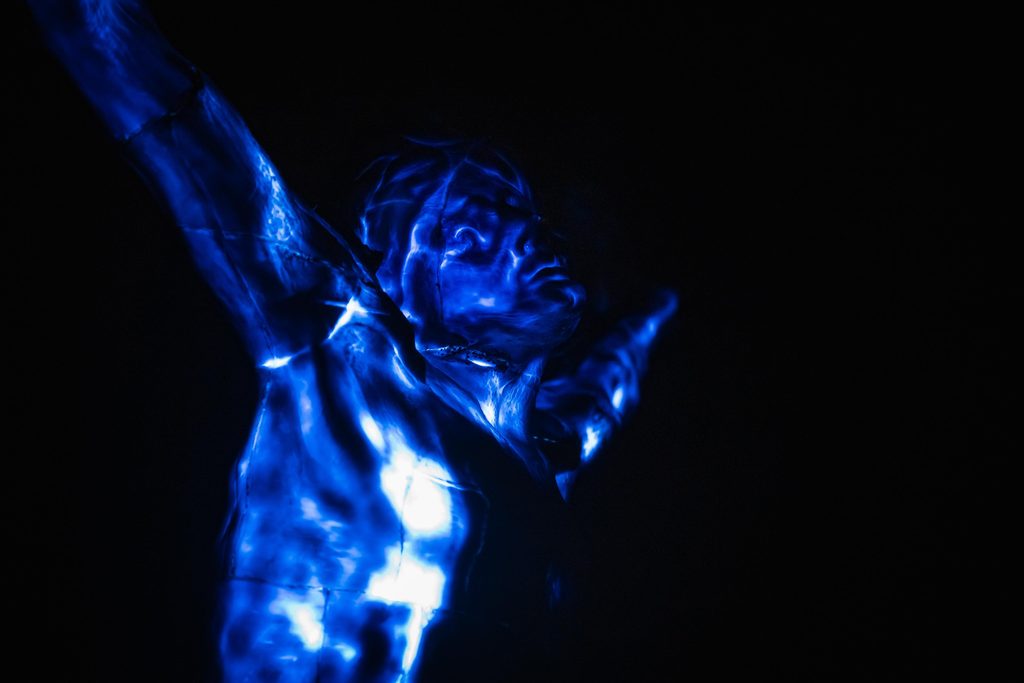
For Clint Calleja, this inquiry begins beneath the visible surface. His installation, X-Corpus, revisits the life-sized crucifix at Tarxien, whose conservation he was directly involved in during his time with RECOOP. The work takes as its point of departure the X-ray imagery produced during the diagnostic examination of the crucifix. Rather than reproducing its familiar iconography, Calleja translates these images into channels through which light activates the structure from within. A technology ordinarily employed to investigate and document an artwork becomes the very means through which a new image emerges.
The installation echoes the niche housing the original crucifix. Its dark enclosure surrounds the illuminated body, evoking the unresolved tension between suffering, death and presence. A reflective surface on the reverse confronts visitors with their own image before they enter the chapel. This is not an invitation to vanity, but to conscience: before encountering the image, the viewer is made aware of their own presence. In X-Corpus, visibility is no longer simply a matter of illumination. It emerges through scrutiny, mediation and an acknowledgement of vulnerability.
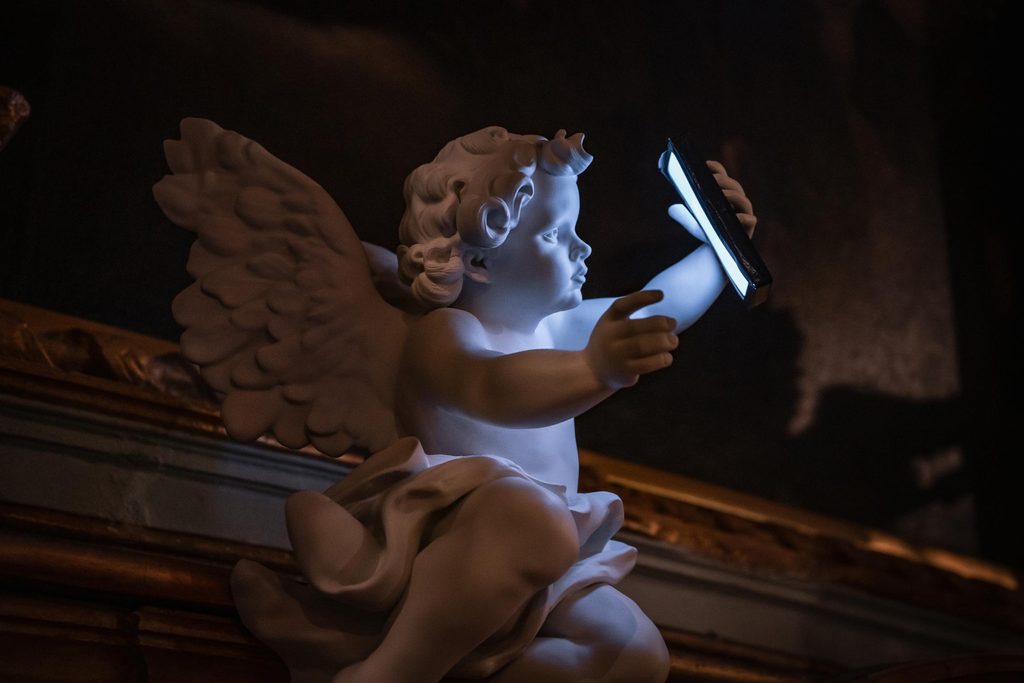
Pierre Portelli’s Kerubini shifts the inquiry from the material survival of the artwork to the survival of its image. Taking Mattia Preti’s restored Madonna Portiuncola as its point of departure, the installation presents five cherubs holding mobile phones and photographing the altarpiece. Traditionally, these figures serve as intermediaries, directing the gaze of the faithful towards the sacred. Portelli retains this function but replaces their conventional attributes with contemporary devices of image capture.
The gesture raises questions about the status of the image in an age of digital reproduction. Preti’s painting remains a singular material object, subject to ageing, deterioration and conservation. The photograph, however, becomes data: reproducible, transferable and capable of circulating far beyond the place in which the original exists. Benjamin’s reflections on mechanical reproduction and the changing conditions of an artwork’s aura acquire renewed relevance. Yet Kerubini is not simply a lament for the loss of authenticity. It also recognises that images have always depended upon the means through which they are transmitted and encountered. Even the visitor who photographs the cherubs photographing the altarpiece becomes part of the circuit of images that the work sets in motion.
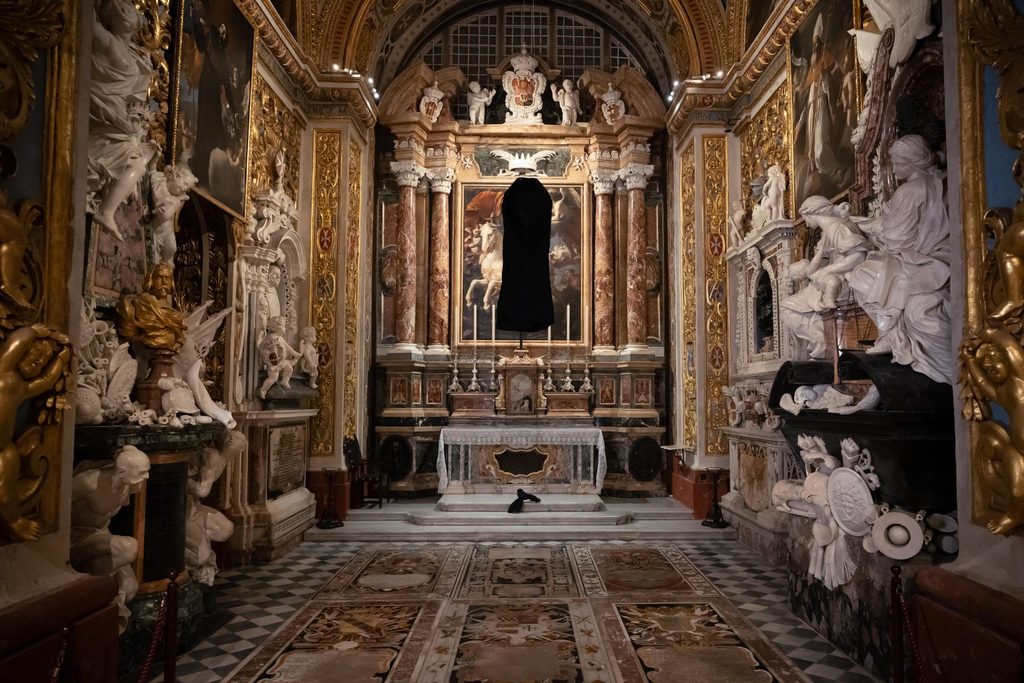
Austin Camilleri turns towards what conservation has removed. His installation, Stuta, takes its point of departure from Guidi’s monument to Grand Master Nicolas Cotoner. During its conservation, layers of soot and accumulated residues were removed to reveal the luminosity of the monument’s gilded surfaces. Camilleri retrieves this discarded material and transforms it into materia prima. A life-sized cape, recreated in wax and soot, is suspended in the Chapel of the Langue of Aragon. Derived from the bronze cloak of Grand Master Antoine de Paule, an earlier work by the artist, it relinquishes the solidity and weight associated with monumental authority. What remains is a fragile garment without a body, a symbol of power after the disappearance of its wearer.
The contrast is deliberate. Where Cotoner’s monument asserts grandeur, victory and permanence, Stuta introduces fragility, absence and decay. The captive figures at the base of the monument, representing African and Turkish captives, also invite a reconsideration of the human cost concealed within historical narratives of domination. The intertwined wax hands, marked with the same soot and placed on the altar, offer a counterpoint to the cape: a gesture of connection, solidarity and shared vulnerability.
Here, the discarded residue becomes a material witness to what the splendour of the monument might obscure. The gesture recalls Walter Benjamin’s insistence that the history of civilisation cannot be separated from the histories of violence that accompany it. It also resonates with Theodor Adorno’s understanding of art as bearing the marks of suffering and contradiction, resisting the temptation of an easy reconciliation. Camilleri does not attempt to rewrite the monument. He unsettles its visual language, redirecting attention towards those whose lives have been diminished or excluded by the exercise of power.
Although distinct in form, the three installations converge around a shared concern: the conditions under which meaning survives. Gianni Vattimo’s notion of pensiero debole, or weak thought, offers a useful philosophical framework. Meaning is not fixed in an immutable past but remains subject to historical interpretation and transformation. In this sense, conservation is not the recovery of an absolute original. It is an encounter with an object whose identity has been shaped by time, use, deterioration and successive acts of interpretation.
Allegoria proposes that the afterlife of an artwork lies not in its ability to remain unchanged, but in its capacity to acquire new meanings. Through light, residue and digital images, the three artists establish a dialogue between the material and the immaterial, the sacred and the contemporary, what is remembered and what is forgotten.
The project ultimately asks us to look beyond the appearance of permanence and consider the histories that objects carry, including those that their monumental forms may conceal. Perhaps what survives is not always what was intended to last. Sometimes, it is precisely what remains after everything else has burned.
Allegoria is a contemporary art production by RECOOP, curated by Andrea Depasquale.
Clint Calleja’s work at the Parish Church of the Annunciation in Tarxien is open for viewing on Thursdays and Fridays from 17:00 till 20:00 and on Saturdays and Sundays on from 09:00 till 12:00 and from 17:00 till 20:00. Pierre Portelli’s work at the Church of St Francis of Assisi in Valletta is open daily from 07:00 till 12:00 and from 16:00 till 18:30. Austin Camilleri’s work is available for viewing in accordance to the opening hours and visitation policies of St John’s Co-Cathedral in Valletta.