Omenaa Mensah
Redefining: Polish-Ghanaian Textile Narratives – Best Pavilion, Malta Biennale 2026
Omenaa Mensah’s OmenaArt Foundation pavilion at Birgu’s Old Armoury weaves Polish and Ghanaian textile traditions into a monumental dialogue on heritage, identity, and ubuntu. Featuring Ernestina Mansa Doku, Eliza Proszczuk, and Marta Nadolle – curated by Natalia Bradbury – this Falcon-winning project bridges cultures through residency-born installations.
AP: What inspired you to back this Polish-Ghanaian project for Malta Biennale 2026, especially funding the residencies and large-scale textile works during the open call?
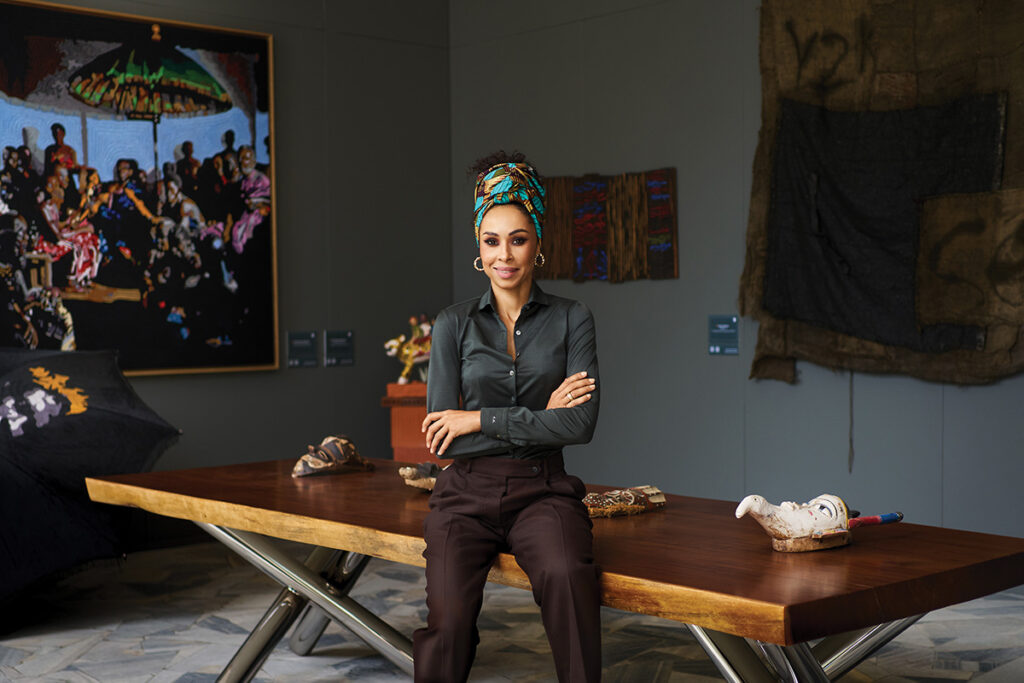
OM: My commitment to this project is deeply personal. As someone shaped by both Polish and Ghanaian heritage (my mother being Polish and my father Ghanaian), I have always felt a profound responsibility to build meaningful bridges between these two cultures. Through the work of the OmenaArt Foundation, which I founded as a women-led initiative, and Omenaa Foundation, we have been actively engaged in Africa for over a decade, supporting and empowering artistic development.
What inspired me was the fact that textile art, particularly in Poland and Malta, carries a strong feminine lineage. It is a medium historically associated with women’s narratives, craftsmanship, and storytelling.
Supporting artists such as Ernestina Mansa Doku, a graduate of the Kwame Nkrumah University of Science and Technology in Kumasi and a recipient of our Artis Arundo scholarship in 2024, is both a privilege and a natural extension of our mission. We are incredibly proud to witness her rapid artistic growth and increasing international recognition.
We are also very honoured to work with Polish artists Eliza Proszczuk and Marta Nadolle, each bringing to the project their unique, compelling, research-driven practices that explore materiality, identity, and the social dimensions of textile and visual culture. Creating a space where these voices can meet, exchange, and evolve together is at the core of what we do, ensuring that the dialogue is not centred around a single narrative but unfolds through a plurality of perspectives and experiences.
Funding residencies and large-scale textile works was therefore a deliberate decision. Residencies provide artists with the essential time, space, and context to create site-specific works that respond authentically to place. For us, it was important not only to support production but to enable a deeper artistic dialogue rooted in lived experience and cultural exchange.
AP: The Falcon Award validates your curatorial gamble on an unprecedented Polish-Ghanaian-Maltese textile dialogue – did anything surprise you about how Biennale audiences engaged with these works, and how has the win reshaped OmenaArt’s approach to future cross-cultural commissions?
OM: The success of this project has been profoundly meaningful for all of us, not only as a validation of the idea itself, but as a testament to the extraordinary collective effort behind it. It is the result of the dedication of an exceptional curator, Natalia Bradbury – who is also the Executive Director of the OmenaArt Foundation and Phenomenaa Gallery – and a committed team, both in Poland and in Malta, who worked tirelessly for months, attending to every detail with precision and care. Above all, it is thanks to the artists we chose to trust. Their vision, sensitivity, and the final outcome of their work exceeded even our most ambitious expectations.
I was genuinely and positively surprised by the depth of audience engagement. What resonated most strongly was how a very specific narrative – the Polish-Ghanaian relationship in the 1960s – could evolve into a universal message aligned with the philosophy of ubuntu: “I am because we are.” While rooted in African thought, this idea feels more relevant than ever on a global scale today.
The success of this project has reaffirmed our belief that cross-cultural dialogue is not only meaningful but essential. It has encouraged us to continue exploring intersections between these worlds – something that is both deeply connected to my identity and increasingly significant within the global art landscape. In particular, the growing visibility of African art in Europe, including Poland, reflects an important cultural shift that we are proud to actively contribute to.
We are continuing this momentum with upcoming initiatives. On 17 April, we opened the annual TOP CHARITY Art exhibition at the Orangery of King Jan III’s Palace in Wilanów. This exhibition is a powerful example of cross-cultural dialogue: featuring a monumental work by Ibrahim Mahama (ranked number one in ArtReview’s 2025 Power 100) presented within a historic Polish Baroque royal setting. Alongside him, we are showcasing leading figures of the contemporary African and diasporic art scene, including Amoako Boafo and Rita Mawuena Benissan.
In dialogue with these artists, we are also presenting works by legendary Magdalena Abakanowicz, whose monumental works transformed Polish and global perceptions of textile art, as well as Ewa Juszkiewicz, one of Poland’s most important contemporary artists. This year marks the 5th anniversary of the TOP CHARITY initiative, and we are also expanding our activities through the development of the Phenomenaa Gallery, dedicated to African and non-European art in Poland. The response so far has been exceptionally strong, confirming that this direction is both timely and necessary.
AP: What are the next steps for sustaining this Polish-Ghanaian-Maltese collaboration, and how does OmenaArt envision Malta’s role in future art exchanges?
OM: Looking ahead, we are focused on strengthening long-term structures that enable sustained and meaningful collaboration. Our residencies and exhibitions in Malta are all part of a broader, evolving initiative: Luginsland of Art. At the heart of this project is the 19th-century Villa Luginsland, which we are currently revitalising into a dynamic space for artistic exchange.
It was within this historic setting that the Space & Time exhibition took place in 2024, bringing together Polish and Maltese artists. Our residency programmes continue to grow, with Polish artists coming to Malta each year to engage with its cultural landscape, architecture, and local artistic community, including collaborations with artists such as Victor Agius and Justin Falzon. These experiences are designed not as isolated initiatives, but as part of a wider ecosystem.
Equally important is how Malta connects with our activities in other regions. We are developing projects in Ghana, such as the Kids Haven Sport & Art Complex – an innovative multidisciplinary centre initiated by the OmenaArt Foundation in collaboration with curator Azu Nwagbogu – as well as expanding our initiatives in Poland. We intend to create strong, organic links between these geographies, ensuring that Malta becomes an integral node within this network.
Through this approach, we also want to actively support and promote Maltese artists internationally by integrating them into exhibitions, residencies, and collections across our platforms. Malta, with its unique position between continents, holds symbolic value for us—as a natural point of connection through which we can continue to build meaningful cultural bridges between Europe and Africa.