ŻAFŻIFA
A Cinematic Drift Through Malta's Concrete Margins
Interview with Writer-Director Peter Sant
Shot on 16mm with non-professional actors and open sets, Żafżifa (2025) follows Dimitrios, who returns to Buġibba and finds himself increasingly alienated by the rapid transformation of the place around him. As construction, tourism, and economic expansion reshape the town, he drifts through a world of concrete until he meets Annie, a foreign caregiver whose own life is marked by absence, disappointment, and emotional distance. The film premiered at the Cairo International Film Festival and is now screening in Maltese cinemas.
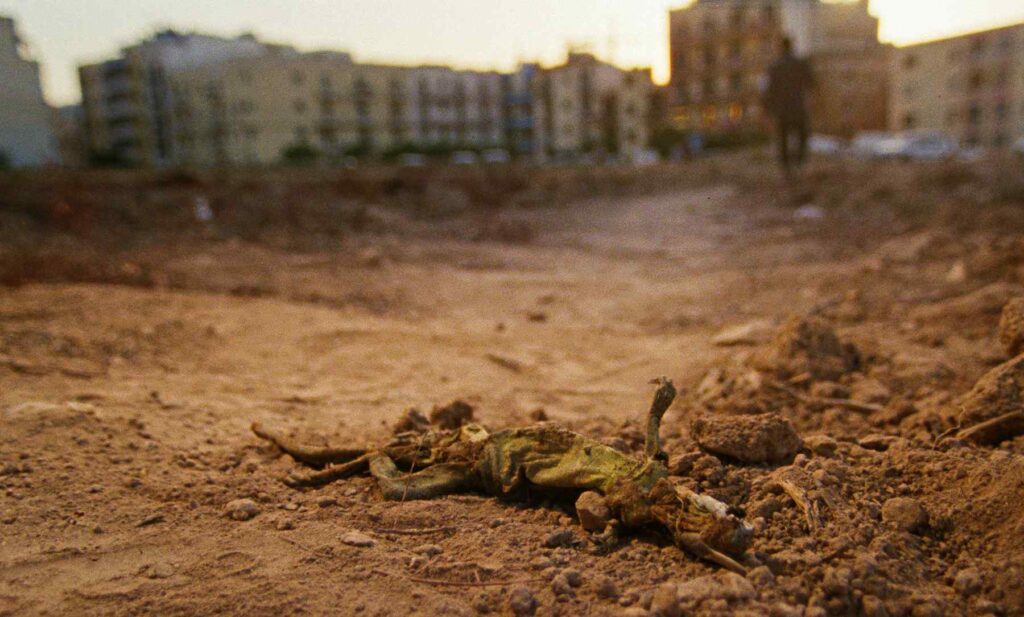
Q: Żafżifa is rooted in Buġibba and in the pressure of “progress.” What drew you to explore the notion of progress? A: Buġibba is an area that has experienced rapid population growth over a relatively short period of time and, in turn, has undergone a significant demographic shift. I wanted to explore the emotional and psychological consequences of this transformation. Of course, these changes are not just happening here in Malta, but in many other places around the world. Ultimately, I wanted to try to understand how we are conditioned by the environment we live in, how different people deal with that, and the repercussions it can have.
The idea of progress was central to the film. This belief in an upward trajectory toward a future somehow better than the present was something I wanted to explore. Dimitrios’ character embodies that. He decides to distance himself from the progress that surrounds him, returning to the island to find that his old friends have moved on with their lives and taken advantage of the changing economy. Along the way, he also meets new friends, some of whom are economic migrants. He moves through the town more like a Baudelairean flâneur — observing, absorbing, drifting through spaces in transition. Through him, my intention was that the audience become attentive to the background details and question them — this is particularly interesting when screening in Malta. Viewers sit in a dark cinema watching a depiction of the world right outside and, once the film is over, find themselves back in it. This, in itself, encourages a different and hopefully deeper reading of the work.
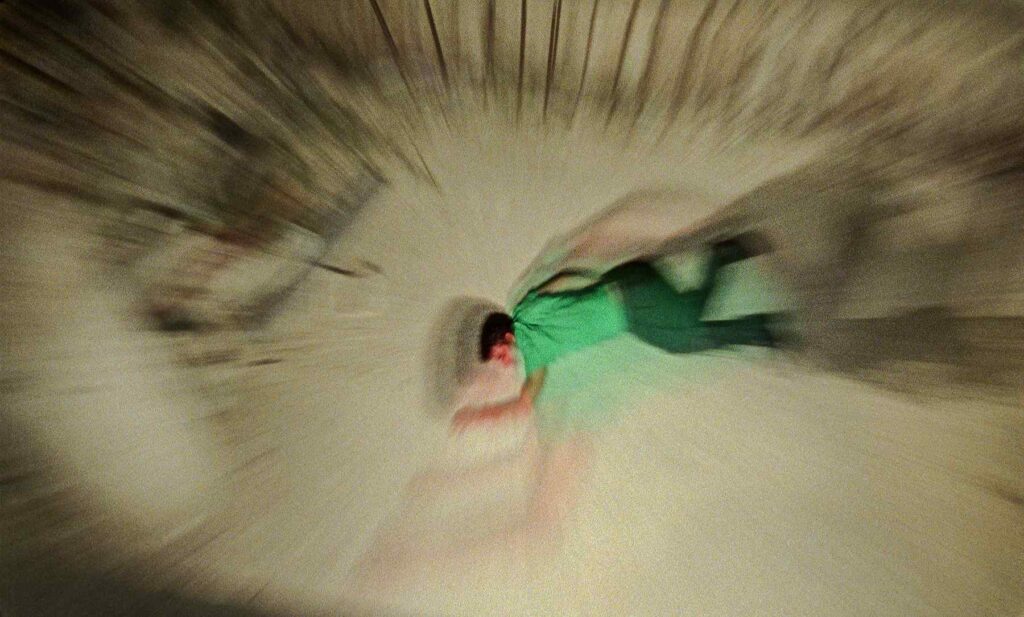
Q: The title is striking. What does Żafżifa mean to you? A: The title came very late in the process. Żafżifa is an obscure Maltese word for the noise produced when liquid or air oozes through an aperture. There’s a scene in the film where, after Dimitrios turns up at Karim’s house unexpectedly, we see a large bouncy castle deflate to reveal a church in the background. For me, this image seemed to capture almost everything I was trying to say with this film, and the title points towards that.
Q: Why was 16mm the right medium for this story? A: It’s an outdated format and a real pain in the ass. Loading, unloading, sending the film abroad for processing, and waiting days before you get to see what you shot. However, for me, there are aesthetic benefits, a certain grunginess – the dirt, the scratches, the hairs. They’re all there in the frame.
But more importantly, for me, it evokes a sense of nostalgia, which I felt is crucial to the work. The film naturally takes place in the present while also questioning the idea of progress and, through that, what the future may bring. At the same time, shooting on 16mm introduces an image that already feels haunted by the past.
The past feels fixed and complete, which is perhaps why nostalgia can be so seductive. “Nostos” is the Homeric word for homecoming and “algos” means pain. This all ties into Dimitrios’ character, relating him to Odysseus’ return to Ithaca.
Q: You’ve spoken about removing authorship from the work. How did that shape the production?
A: Film is, as we all know, a collaborative pursuit. The idea of a director as a kind of puppeteer is not something I’m particularly interested in. A lot of film productions administer complete control over everything, the colour of the walls, the choreography of extras and traffic, the drinks, costumes, light and of course a silence on set to allow complete control of sound.
There’s also a certain hierarchy on film sets: director, producers, camera department, etc. I remember working on the film Troy (2nd unit) here in Malta when I was younger. There were strict instructions not to talk to the main cast. The crew were throwing themselves at the Director in the hope of getting more work while he bragged about how many cameras he destroyed on his last production. The camera team were like a bunch of annoying lead guitarists who won’t shut up demanding they fly first class to the next location so they can take their golf clubs.
There was one night shoot I recall where the city of Troy was to catch fire, stunt men on fire jumping from buildings. The big climax being this huge statue falling, crushing people. The crew spent all night preparing and were ready to roll at the crack of dawn. Everything was organised down to a tee. So all the fires were started, the extras running around screaming, cameras everywhere covering every possible angle. Lo and behold, once it was over the statue remained standing. Directors and producers started screaming. The guys whose job it was to collapse the statue replied, “No one cued us.” It was enough to turn me off for life.
This, to me, isn’t a side of filmmaking I wanted to be a part of. All money and spectacle. I prefer working with a smaller, more intimate crew who collaborate to make something they believe in. Something with purpose – necessity.
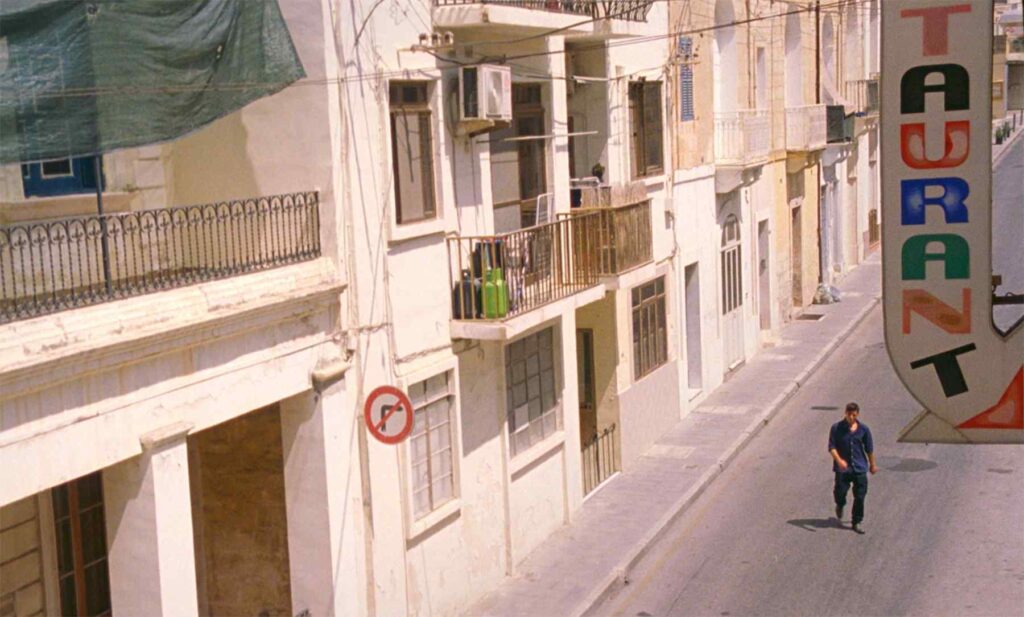
Shooting with open sets allows me to relinquish control and permits new meaning to emerge. I felt things had to remain incomplete from my side in order to allow this to happen. We would start off with a simple idea for each scene, but once you take that out onto the street you immediately open yourselves to a wonderful unpredictability, placing both cast and crew in situations where they are forced to respond to what is happening around them. Same with scenes where the cast are speaking their own language. There are various stages of translation from script to performance, to subtitles, and again new meanings, new associations materialise through it. This, for me, lends a certain vibrancy, a kind of rapid circulation that became a crucial part of the film.
Q: Dimitrios is surrounded by people who seem to adapt more easily to the changing economy. Is the film about being left behind?
A: Not at all. It sets out to question those changes. He, like all of us, is situated in a world driven by profit and greed. He simply decides to separate himself from all that, much like the Greek philosopher and founder of cynicism, Diogenes. So it’s not about being left behind, it’s about finding an alternative, which of course is an impossible pursuit ultimately ending in failure and a sense of deflation. This is symbolised by the scene where we see the bouncy castle deflate to reveal the church – a symbol of Christianity and its indelible ties with colonialism, and in turn, progress – the defining idea of modernity.
Q: Annie and Dimitrios seem bound together by shared vulnerability. What do they represent in the film?
A: Annie, and a lot of the other cast members who represent the changing diaspora, also, to me, represent, in a sense, the ruins of progress. This all still seems quite new here in Malta. But much like my own parents, and so many others during that period, who migrated to Australia (and elsewhere) for economic reasons, they have become a crucial part of this so-called progress. Fortunately, my parents’ generation were able to prosper from that, giving them the resources to afford homes, raise a family and secure a healthy pension. It’s no secret that these days, this is hard for even local residents, let alone third-country nationals.
Ultimately, Dimitrios and Annie are forced apart by circumstance, their struggle to survive and their position in society. They serve as a reminder of the global unevenness of “progress” that imagined European imperialism as a civilising mission inflicted upon “backward” others for their own sake.
Q: Żafżifa has been described as a portrait of contemporary Malta, but also as something more universal. Was that always part of your intention?
A: We have been living in London for the past twenty years and even there, there are new apartment blocks going up everywhere. The only difference being that they are marketed in a way that promises healthy (i.e. yoga, pilates), culturally rich living (i.e. art, expensive food and coffee) in an area that was, and in some corners still is, deprived. What I love about the area (Hoxton) was that there’s a certain underlying tension to it all. We lived very close to Hoxton Street, just a short walk away from places like the Angel and Shoreditch. But along that short walk seemed to be an invisible border. Over the years I saw so many fancy restaurants and cafes open in response to the recent influx of wealthy twenty-somethings moving to the area. However, as the population remains, for now at least, predominantly working class, these places came and went very quickly. There seemed to be a kind of resistance to change, perhaps best symbolised by these stickers I used to see saying “Keep Hackney Shit”. To me, it’s a bit like Sliema / Saint Paul’s Bay. You really wouldn’t have to search hard to find other examples.
Q: What do you hope audiences take from the film?
A: Ideally, a screen-printed poster or a limited-release LP. But seriously, I just hope it poses some questions. At best, I hope it serves to inspire younger filmmakers to get out there and shoot stuff. Malta, in regard to filmmaking and art in general, is very much a blank canvas — there’s so much to explore.
Tickets: