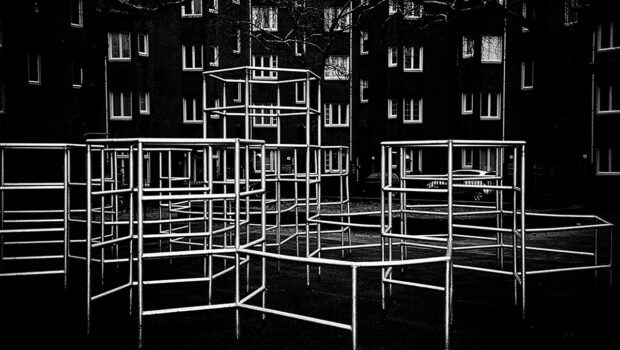
PLAYGROUND WAREFARE
Berlin Art Week will once more have a Maltese institutional representation at this year’s edition
In a collaboration between R Gallery and AOA:87, SEE/SAW builds on the success of the joint exhibition by both galleries, FAR REACH in 2023, and features the work of Kane Calì and Madeleine Fenwick. ANDREW BORG WIRTH sits with both artists to speculate further on the aims of the project.
There is little doubt, upon seeing these works, that SEE/SAW comes at a time of war. We live inundated with images, messages and proclamations of alliances, betrayals, progression and regression, as promises of peace repeatedly collapse back into violence. In the works of Calì and Fenwick, these are displayed front and centre. As war escalates before our eyes, the line between truth and fiction is tense. We know that the agenda of who is telling the story is embedded within how it arrives at us. What we can’t decipher is what to make of it all.
This helplessness is ironic when considering that war has, for decades, been fed to us as an act of play. Children immediately recognise a soldier. They seek out camouflaged outfits and helmets as if the military were welcome guests at a costume party. They play with toy weapons seemingly as harmless as buckets and spades in a sandpit. They are, like us, unable to decipher the gravity of what all this does to us. Their fictional play mirrors a much uglier global reality.
‘Human Grenade’ by Kane Calì, presented in different scales, plays on this irony. The series of works embed the artist’s own image into the form of a hand grenade; a powerful object which explodes as its pin is pulled. The sculptural irony of the grenade is magnified and diminished at different scales. Presented as 3D-printed objects or flat in a series of wall-mounted prints, they recall the mass-produced toys which children are often presented with. The fabricators Kane worked with, wary of the intentions of the artist, only produced a part of the required components. Everything had to be verified to ensure that this was anartwork with no ability to be triggered and explode. Again, we are at the tense line between truth and fiction: a grenade with no power presented as a powerful artwork.
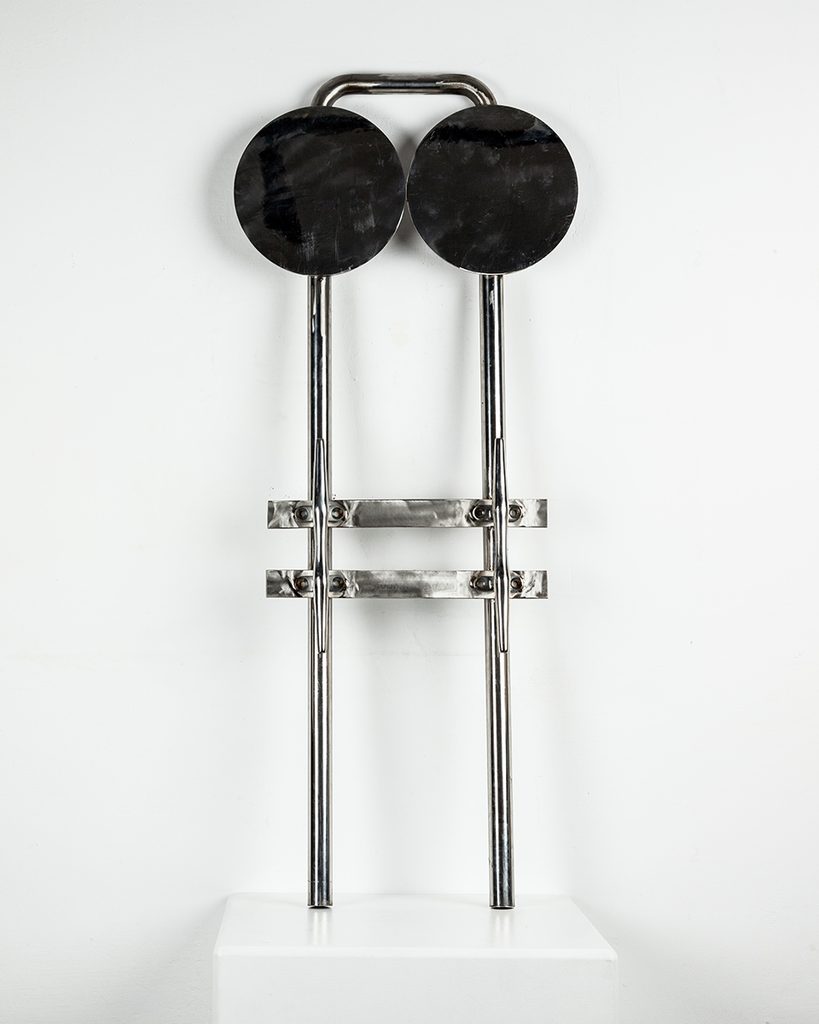
This sits within the same space as “Seesaw / Equilibrium of Consideration”, the monumental sculpture by Fenwick, from which the exhibition borrows its title. Here, audiences are invited to play. The sculpture is monumental and brutally made of ready-mades and specifically designed pieces. The two seats imply a binary condition, but a seesaw is rarely in equilibrium. The artist speaks of a war we are at with the other; a playful chance for both to rise or fall. The strongest trope here is one of precariousness, which follows through the full selection of works.
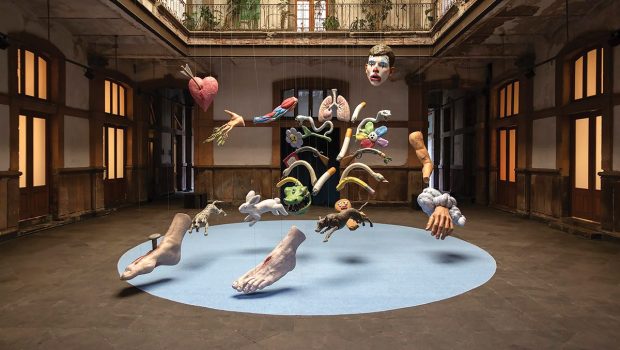
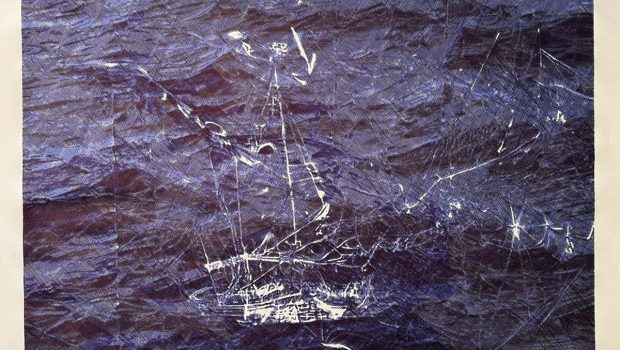
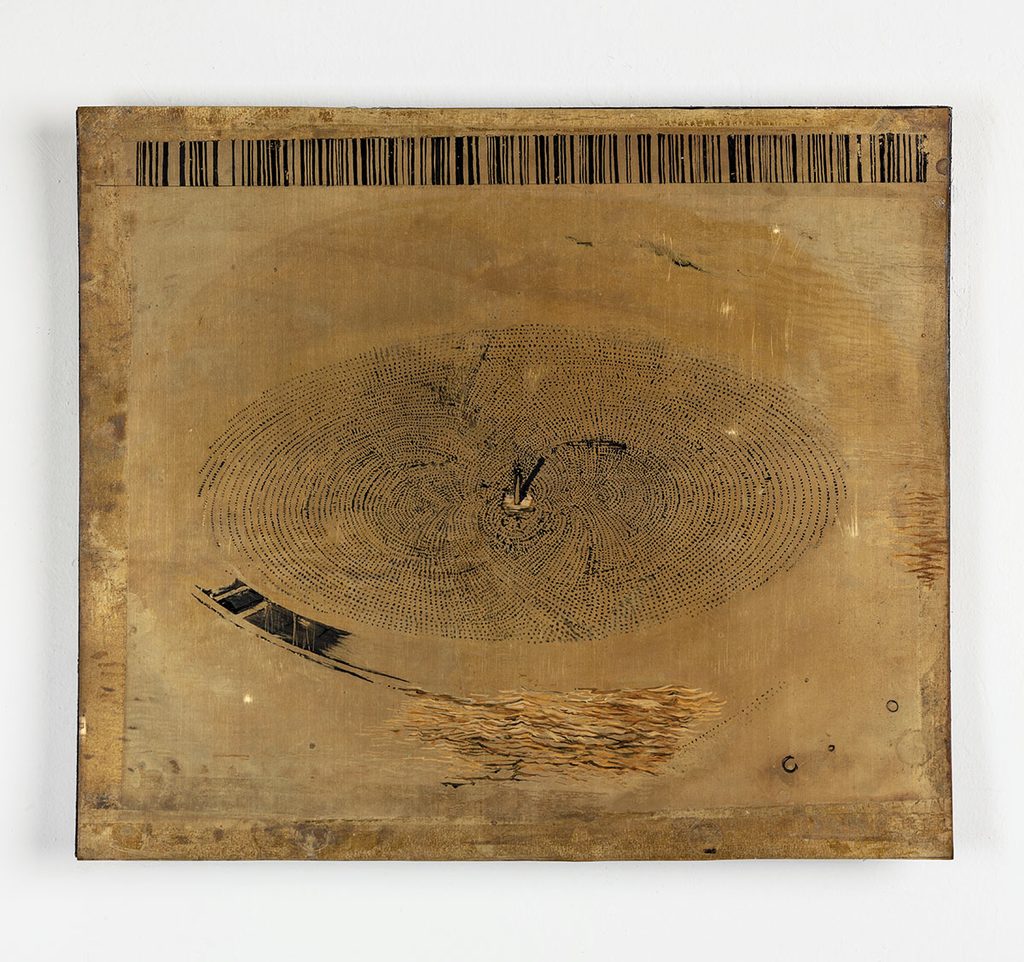
There is an abundance of metal within the group of works. Embedded with memory from wherever it was extracted, manipulated, engineered, used, collected and recycled, it was ultimately poured back into the artworks flown from Malta for this exhibition in Berlin. The works perform almost like shrapnel on the wall. In different ways they convey the inert substance of war, violence and crises. There is calamity in ‘No Looking Back’ and ‘Huitzilopochtli’ by Madeleine Fenwick. There is altered perception in the ‘Looks Up in Horror’ series by Kane Calì: if seen from one angle, the figures in these works are perceivable, but moving just a short horizontal distance completely rids the artwork of representation. The limits of the material are tested in both artist’s work; battered and punctured in the paintings by Fenwick; fluid but tactile in the works by Calì.
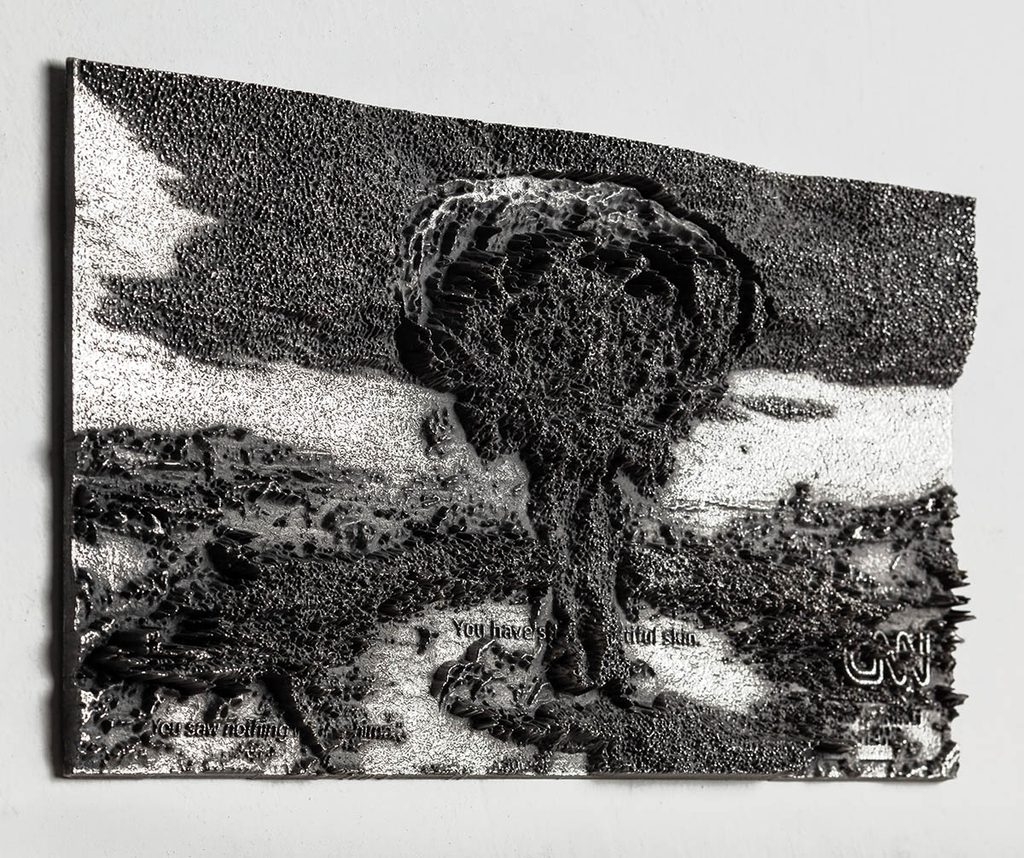
The inevitability of crisis is best conveyed in the text works that both artists are producing. There is a flatness in Fenwick’s brass plates which almost ridicules the statements they convey: ‘PEACE’ or ‘HE SAID/SHE SAID’. The show gains momentum in the glitched tablets by Calì. A pastiche of media network logos, breaking news imagery and texts across languages, they are caught between different truths and agendas. Again there is something child-like and playful in their manifestation, if only they weren’t built of such a visceral, dangerous, raw metal, which, when touched, could tear at your skin. ‘Hiroshima De Ja Vu’ borrows from both the real imagery of the 1945 disaster, and the subtitles lifted from the 1959 film directed by Alain Resnais, Hiroshima mon Amour.
SEE/SAW feels urgent, but peculiar. It is uncomfortable to think of the ugliness of the onset of war and the inevitability of the apocalypse, from within a playground. It’s as if the artists are commanding us to see the world in the same way playing children are made to. At either seat of the seesaw are two children: a weightless plastic toy soldier and a blank-faced desperate orphan child in a war-zone. The toy soldier is frozen high in the air; his playmate grounded adamantly to the floor. Silent audiences will face a series of loud statements from the two artists from Malta, this September in Berlin.
—
SEE/SAW runs between 11 September – 31 October 2026 at AOA;87 ; Sophienstraße 5; 10178 Berlin. The exhibition is produced and presented by Angela Kohlrush and Jonah Kittlemann of AOA;87 and Mark Sullivan and Kathrine Maj of R Gallery. Opening: 10 September, 6 – 9 PM. Press by appointment from 9 September 2026