In Between Malta and Korea
Building BEJN in Gwangju
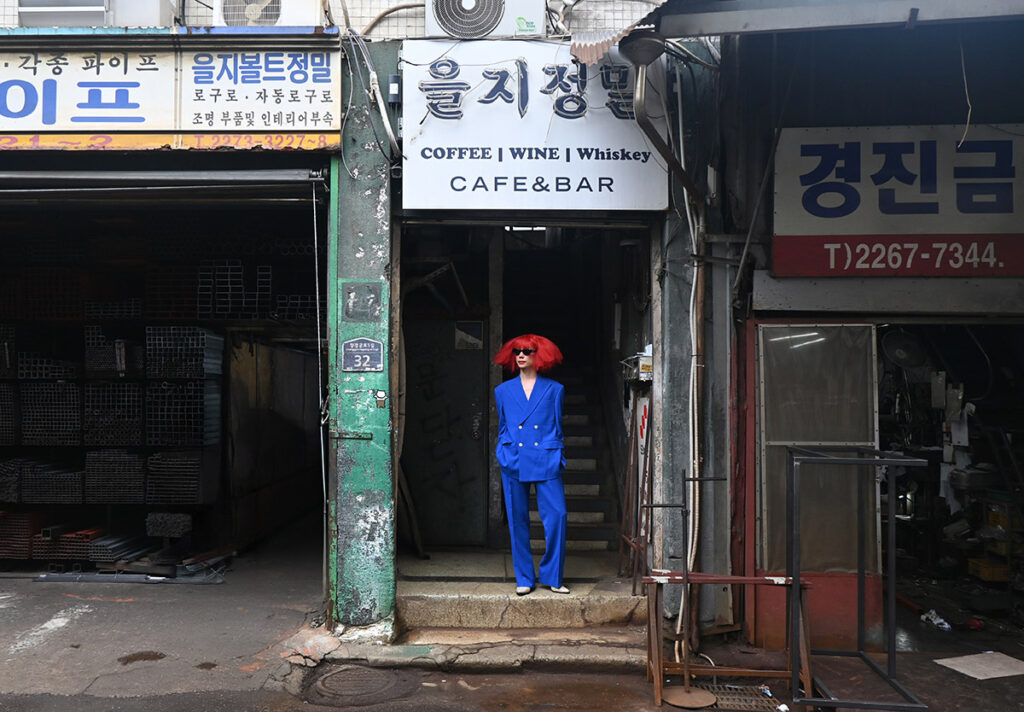
Written by Sam Alekksandra 3 weeks before the opening, in the thick of installation
There is a particular strangeness in travelling more than 9,000 kilometres to make work about what exists between things.
For the past months, a group of Maltese artists has been living and working in Gwangju, South Korea, preparing Malta’s first-ever Pavilion at the Gwangju Biennale. On the 5th of September, BEJN / In-Between opens at Horanggasy as part of the 16th Gwangju Biennale, bringing together Norbert Francis Attard, PONKS — the collective I share with Julien Vinet — and sound artist Michael Quinton.
The exhibition began with a deceptively simple proposition: what can happen in the space between two things?
For PONKS, the in-between has always signified possibility. It is an openness that poetry and contemporary art can facilitate: a state in which something has not yet resolved into one meaning. A poem changes according to who encounters it and when. The poem I read today is not necessarily the poem I read five years ago. I have changed, and therefore the poem has too.
When we began working with poets from Malta and Korea, we became interested in extending this question across two cultures. What happens when a Korean poet writes about grief? What happens when a Maltese poet does? What lies between those experiences? What happens when the poems are brought into the same room?
These questions became the starting point for an exhibition that now extends across installation, poetry, sound, performance and immersive film.
But BEJN could never really be made from Malta.
The residency in Gwangju was inherent to the project from its conception. All the artists are developing site-specific work, and being here has allowed the exhibition to be affected by encounters that could not have been planned from a distance. There is something particular about making work in a city so charged with histories of resistance, where art and poetry have themselves played a role in remembering and transmitting history.
Gwangju has been allowed to interfere with the Pavilion.
Finding parallels
Malta and Korea are not obvious counterparts. They occupy different regions, histories, languages and scales of imagination. Yet the longer we worked between them, the more parallels began appearing. I believe the role of the artist is to see parallels where some may not.
Both are relatively small countries surrounded by much larger geopolitical forces. Both have strong traditions of collective ritual and street celebration. Rope carries symbolic and practical histories in both. And language itself produced another unexpected connection.
What struck me were the parallels between Maltese and Korean. Both were spoken for centuries before the writing systems we recognise today took hold: Korean eventually finding its own script in Hangul, and Maltese developing a standard written form through a Latin alphabet adapted to its Semitic sounds. They come from entirely different linguistic worlds, yet both carry a tension between language as it is lived and spoken, and the way it eventually comes to exist on the page.
These aren’t arguments that Malta and Korea are somehow the same. Quite the opposite. BEJN became interesting when we stopped trying to resolve difference.
If you look closely enough, connections appear.
When we first received the plans for Horanggasy, it took us some time to understand the place. The Pavilion is spread across structures a stone’s throw from one another, with dramatically different architectural characters. Once we arrived, the exhibition began finding its way through them quite naturally.
We are all accustomed to working site-specifically, but this is the first time the four of us have worked together in this way. At different points throughout the summer, we have also been living together in Gwangju. Inevitably, practices begin leaking into one another. You see how someone else works. Conversations continue over meals, on site, on journeys through the city. Ideas migrate.
Sound, initially concentrated in Michael Quinton’s work, has gradually begun moving through other parts of the Pavilion. Michael has become, in some ways, a kind of sonic glue between spaces. The result is not a subtle exhibition.
These are large installations, but their scale conceals layers that reveal themselves through time and attention. The journey begins with celebration, harmony, suspension and devastation in Norbert Francis Attard’s works in Artpolygon; moves towards a huge collective act of making in PONKS’ ROPE TEMPLE in Glasspolygon; and eventually descends underground into quieter encounters with sound, language and place.
I hope the initial encounter hits you, and I also hope staying with it changes that encounter.
Between a firework and a bomb
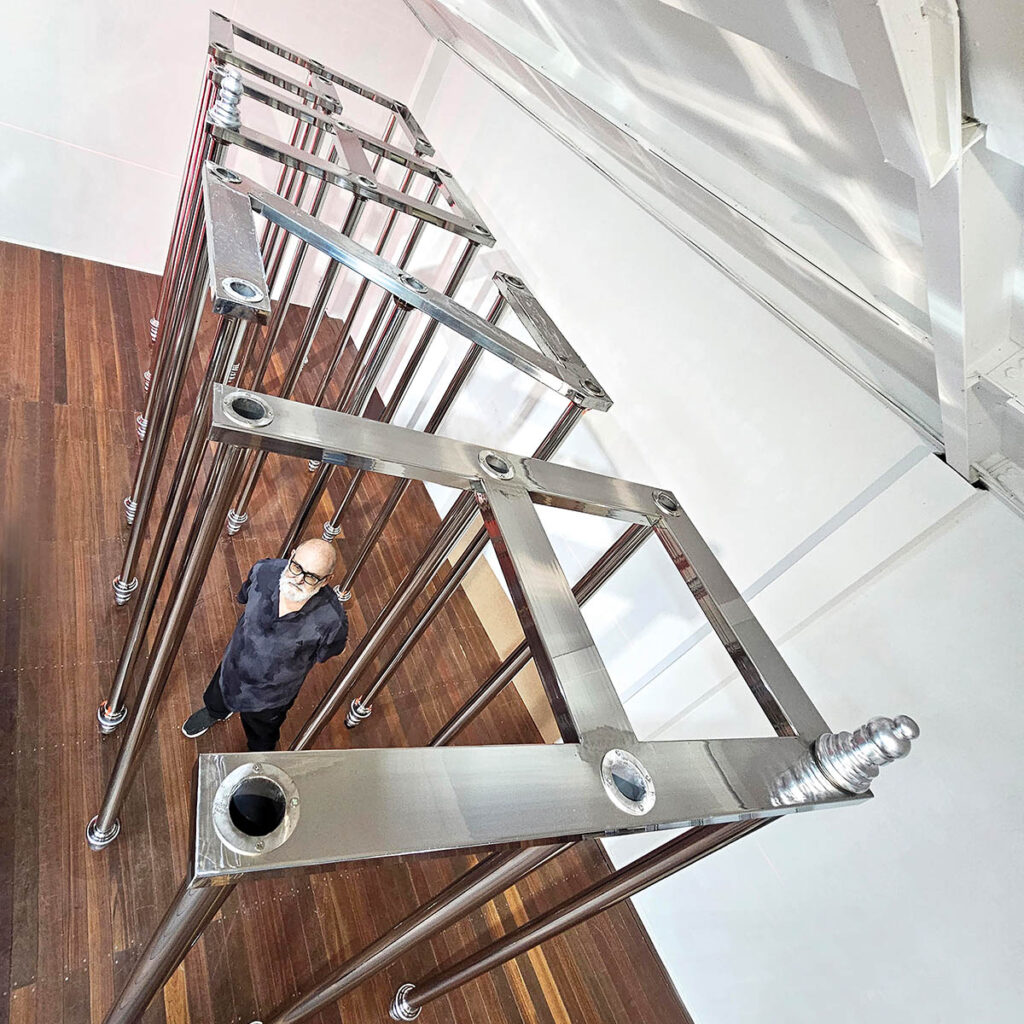
In the Art Polygon, Norbert Francis Attard brings together three realities that initially seem irreconcilable: the Maltese festa, the Korean philosophy of Obangsaek, and Gaza.
An explosion is never simply an explosion.
To someone standing beneath a Maltese summer sky, an explosion might signify celebration: fireworks, a village feast, collective anticipation. Elsewhere, the same sensory event means devastation.
Attard suspends the viewer somewhere between those realities.
His work has evolved considerably since the Pavilion’s earliest proposals. Elements associated with the churches and festas of his beloved Gozo enter into conversation with a word that has become almost unbearably charged: Gaza. It is extraordinary how four letters can now contain so much division, grief and political meaning.
Alongside this sits Obangsaek, the traditional Korean system of five colours associated with directions, elements and principles of harmony. Attard places these different symbolic systems into proximity without forcing them to reconcile.
This is what stays with me when I stand in his space: its scale, certainly, but also the collision between festa and Gaza. Between an image associated with celebration and one associated with destruction.
There is something particularly meaningful for me in working alongside Norbert, one of the pioneers of contemporary artistic practice in Malta, while watching his eye remain restless enough to make these connections anew.
Building a temple
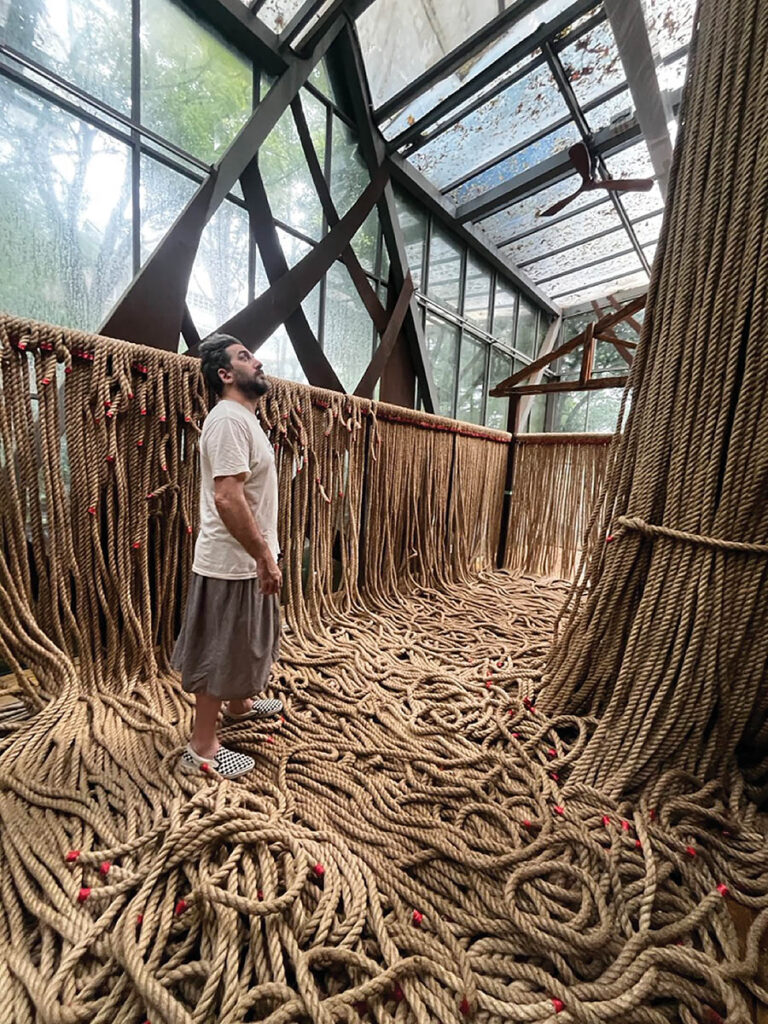
Across the site, the Glass Polygon becomes ROPE TEMPLE, the work Julien Vinet and I have developed as PONKS.
Rope, poetry and the idea of the temple arrived almost simultaneously.
The beginnings of the work existed for another project, but when the opportunity to create the Malta Pavilion emerged, we began dismantling and rebuilding the idea. It became stranger, and it also began making more sense.
Poetry has always anchored PONKS. We are interested in re-enchantment, the future and possibility: in what art can temporarily permit us to imagine.
In ROPE TEMPLE, hundreds of ropes transform the glass architecture into a room within a room. More than one hundred poems from Malta and Korea inhabit its surfaces. At its centre, rope gathers into a dense tree-like structure which the visitor can physically enter and ascend.
The symbolism of rope emerged first through research and then developed through our work with our incredible curator Moon Hyun Jeoung and our time in Korea.
In Malta, rope is inseparable from the sea. It binds vessels, pulls, secures, connects land to water and appears throughout the material language of an island formed by maritime movement.
In Korea, we encountered the geumjul: sacred rope used to mark a threshold and traditionally associated with protection, boundaries and the division between every day and spiritual space.
The rope became the line between worlds.
Why a temple?
Because we are interested in locating the sacred within the everyday. Poetry can be sacred. Attention can be sacred. Touch, labour and collaboration can be sacred.
Audre Lorde famously insisted that poetry is not a luxury. It is a means through which we illuminate and scrutinise our lives. That idea has remained close to the making of this work.
The temple is therefore less a monument to poetry than an environment in which poetry is treated as something alive.
More than one hundred worlds
We knew quite quickly that simply printing poems onto the architecture would not be enough. It was too easy. Too designed.
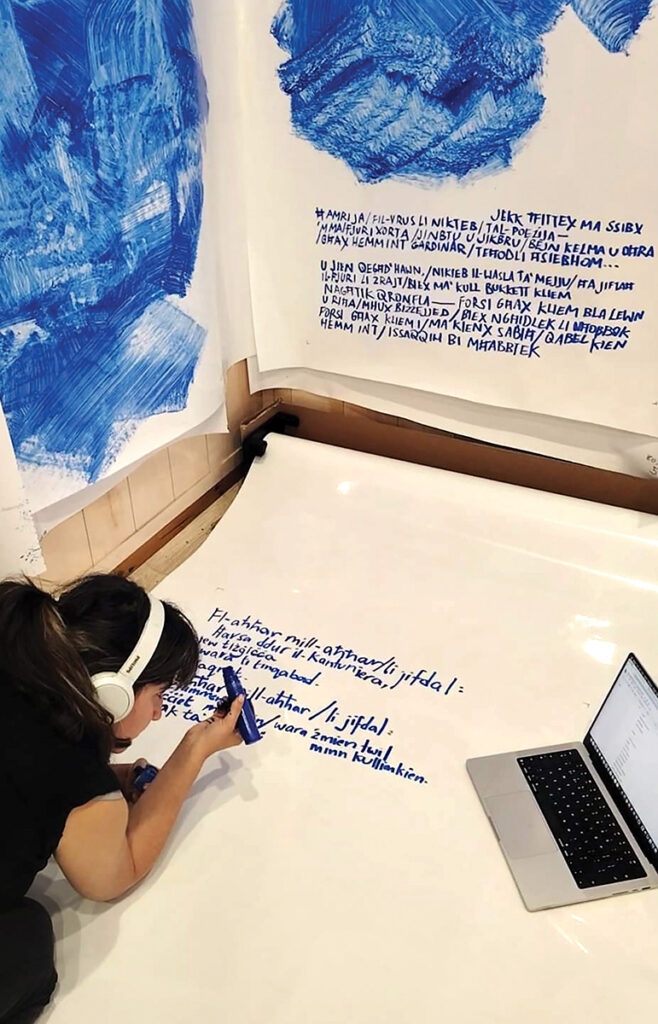
Instead, every poem is being transcribed by hand and accompanied by an abstract gestural work. Each becomes an individual artwork. Making them has become an act of devotion.
This has meant weeks of physical labour in Gwangju: reading, writing, painting, hanging, handling rope, adjusting structures and returning again and again to poems written in languages we do not necessarily understand.
For me, the process is always more important than the final work. Every act of making changes the maker. Learning to write Korean has given me another small key into its mystery.
Importantly, we decided not to make translation the solution to everything.
A visitor may encounter a poem they cannot read.
That is intentional.
We live at a moment in which knowledge has become almost instantaneous. A device can translate a sentence in seconds; AI promises an answer before we have properly formulated the question. We have become accustomed to the idea that everything should immediately disclose itself.
ROPE TEMPLE asks for something slower. Sometimes feeling is more important than knowing.
If someone really wants to discover what a poem means, they can. But for a moment, the poem can first exist as rhythm, gesture, shape, material and evidence of another person. It can remain partially inaccessible.
That gap is also an in-between.
With the help of Gwangju-based poetry curator Jeong Jae-yul, Inza from Girls Bookshop and countless others who generously opened their literary worlds to us, we encountered a Korean poetry scene of remarkable intricacy and vitality.
What particularly struck me was poetry’s relationship to memory here. In Gwangju, poetry has been used to hold moments in history, to give language to events that must not disappear. Poetry is palpably alive.
More than one hundred Korean and Maltese poets now occupy ROPE TEMPLE together. Each poem is treated as a world in itself rather than a fragment subsumed into one collective voice.
The temple is built from their coexistence.
At its centre, visitors encounter the rope tree. They ascend one at a time, their touch activating sonic elements within the work. Participation matters because the installation asks the visitor to undertake something resembling a rite of passage.
You cannot experience it entirely from outside.
You have to enter.
Beneath the temple
Below ROPE TEMPLE, the exhibition changes register.
Three subterranean rooms — Trans/cription, Trans/mission and Trans/portation — consider different roots from which poetry can emerge: word, sound and environment.
If the Glass Polygon is the body of the temple, these rooms are its underground root system.
In Trans/cription, the poems gathered through the project become an anthology of Maltese and Korean voices across languages, generations and traditions.
In Trans/mission, Michael Quinton asks a different question: what does the in-between sound like?
His installation Koinonia (κοινωνία) is built from field recordings and archival sounds gathered across Malta and South Korea. Michael records almost compulsively — environments, incidental encounters, resonances, the things happening around him that most of us allow to disappear.
Koinonia is the Greek word for fellowship, participation and sharing. Here, listening becomes a means through which two distant environments can temporarily inhabit the same space.
The third room, Trans/portation, turns outward again.
For this programme, PONKS invited artists from Malta and Korea to respond to specific locations through immersive 360-degree performances. In Malta, we deliberately avoided constructing the country through its familiar tourist image.
Instead, we chose places that might introduce Malta beyond the lens through which it is habitually presented to the world — places that could even be unfamiliar to Maltese people themselves.
A Freeport normally inaccessible to the public. An abandoned chapel. The eighteenth-century National Library. A lighthouse in Gozo. An artist’s father’s garage.
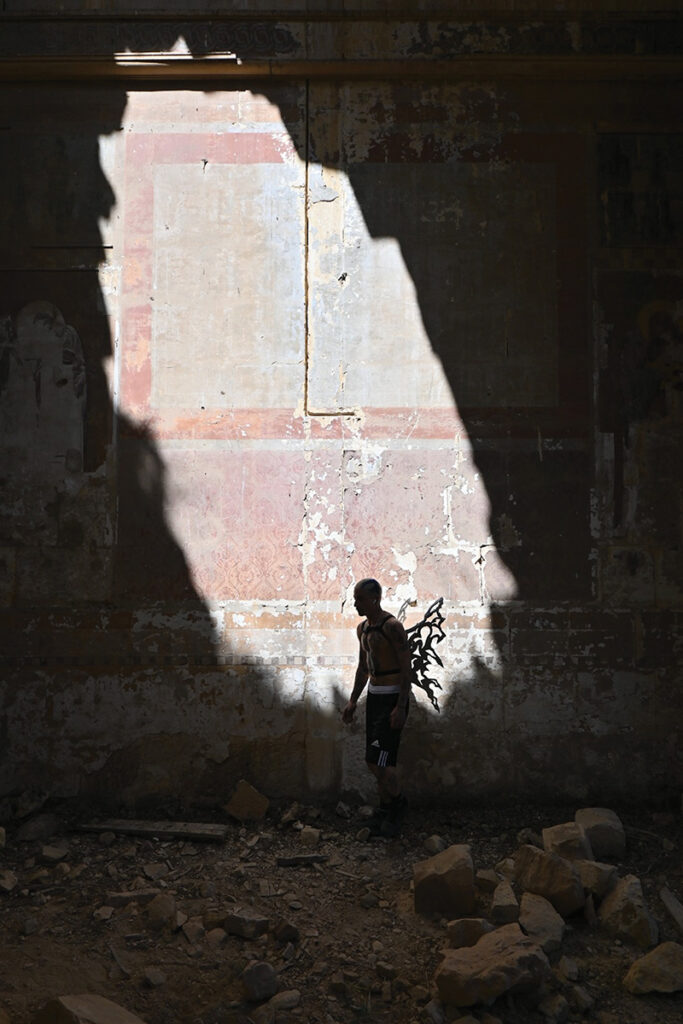
Artists Charlene Galea, Keit Bonnici, Martina Georgina, Romeo Roxman Gatt, Tara Dalli and Félix Deepen inhabit these spaces through their individual practices.
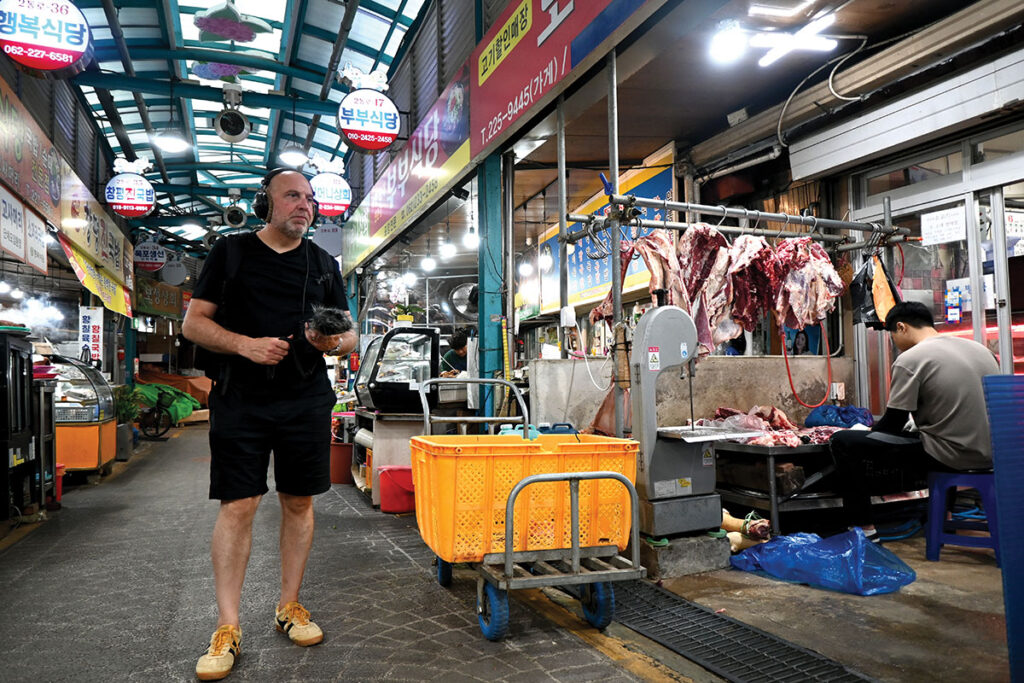
In Korea, the exchange continues with Kim On at the historic Gwangju Theatre and More in Euljiro, Seoul, a district of workshops, industry and memory undergoing relentless transformation.
Experienced individually through VR headsets, the works operate as portals. You do not simply watch another place; for a few minutes your sensory world is displaced by it.
The speed with which we connected with the Korean artists surprised us. This has been true of the project more generally. Again and again, people we encountered here have offered their knowledge, time and energy and become contributors to the work.
Perhaps that generosity is another material from which BEJN has been constructed.
What remains between
There is inevitably something strange about making art under the banner of a nation.
A national pavilion carries expectations: that it might somehow represent Malta, explain Malta, export an image of Malta. But I am less interested in prescribing what a Korean visitor should understand about the country after walking through the exhibition.
I prefer the multitude of things with which someone might leave.
Perhaps Malta appears through the festa. Perhaps through a rope tied to the Mediterranean. Perhaps through the cadence of a poem they cannot understand. Perhaps through the interior of someone’s garage. Perhaps none of those things produce a coherent image at all.
That incompleteness is important.
The same is true in reverse. After months here, I would hesitate to offer a neat explanation of Korea. Gwangju has instead become accumulated encounters: artists, poets, bookshops, streets, histories, meals, gestures of generosity, resistance and the slow experience of trying to make something somewhere unfamiliar.
The purpose of an exchange cannot be to emerge believing that we now completely understand one another.
There must remain some distance.
Some mystery.
Somewhere between knowing and not knowing is the possibility of continuing to look.
By the time BEJN / In-Between opens on 5 September, the exhibition will contain the work of far more people than the names listed as its principal artists. Poets, performers, curators, technicians, collaborators and people encountered along the way have entered it. The three-month residency has made that permeability possible.
Perhaps this is ultimately what the in-between offers us: not compromise, not the flattening of difference into an easy declaration that two cultures are fundamentally the same. Rather, a place in which different worlds can approach one another without having to become one another.
A poem can remain a poem even when I cannot read it. A rope can belong to the Mediterranean and carry an entirely different sacred history in Korea. An explosion can signify celebration to one person and devastation to another. The distance between those meanings is not empty.
It is charged. And that is where BEJN exists. Because humans are capable of great things.
BEJN / In-between runs from 5th September to 15th November. It is commissioned by Arts Council Malta and supported by Visit Malta and the Ministry of Foreign Affairs.