The New and the Absent
The unorthodox forces shaping Venice Biennale 2026 - from curatorial voids and protest interventions to debut pavilions probing global erasures.
The Venice Biennale 2026
When the most beautiful human-made city on earth welcomes the world’s artists and art lovers for a preview of the current state of the known universe – translated and transcribed into the million unique languages of their expression – I feel close to experiencing utopia. My excitement for the opening of La Biennale di Venezia is driven by too many heights to list, but as usual, it’s heightened by the presence or absence of the unorthodox and unexpected. This year, expectations tower over anything past. The last two years have pulled every rug from under us. Perhaps the voids and silences in this edition will be the strongest ambassadors of the “Biennale of Dissent.”
Possibly this year’s most palpable absence is that of the late curator Koyo Kouoh, who passed away unexpectedly, but whose vision will be faithfully carried through by other members of the team she selected.
There’s also the absence of Italian artists in the main pavilion. In a time when Italian nationalism is at its height in decades, this speaks volumes.
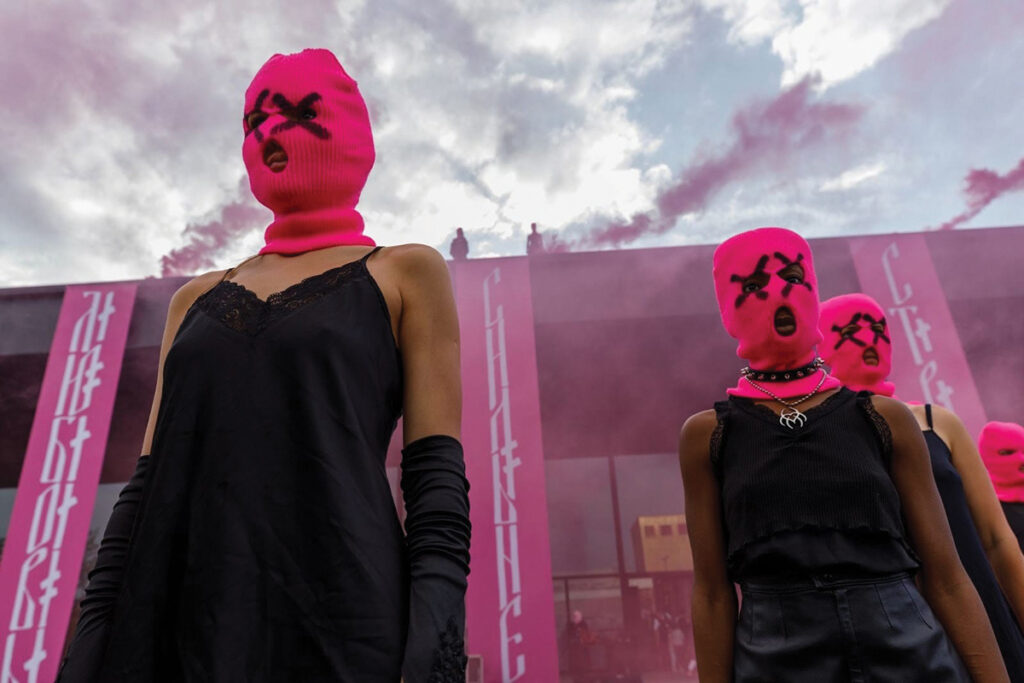
On the other hand, the official Russian selection is palpably present. The artists of the Russian Pavilion from the last Biennale had decided to abscond, and one wonders what surprise awaits us this time.
Pussy Riot, the remarkable Russian feminist punk protest art collective, wrote a letter to the president of the Biennale: “Accommodating official state representation while curating ‘dissent’ risks turning the latter into a performative gesture and virtue-signaling rather than a position. Still, if you are serious about welcoming artists who do not align with state narratives, we are ready to take you at your word. If you would like to support dissent, we will be there. You claim to care about censorship; Pussy Riot is so censored in Russia that we were deemed ‘an extremist organisation’ – simply visiting our website or liking images of our art is criminalised. We request access to the Biennale grounds on May 6, 7, and 8. We do not require any additional support. Please let us know whether this version of the Biennale has room for what it claims to invite. Sincerely, Pussy Riot.”
At time of print, there’s no mention of a reply in the media. I have all my digits crossed for an intervention during the Biennale preview.
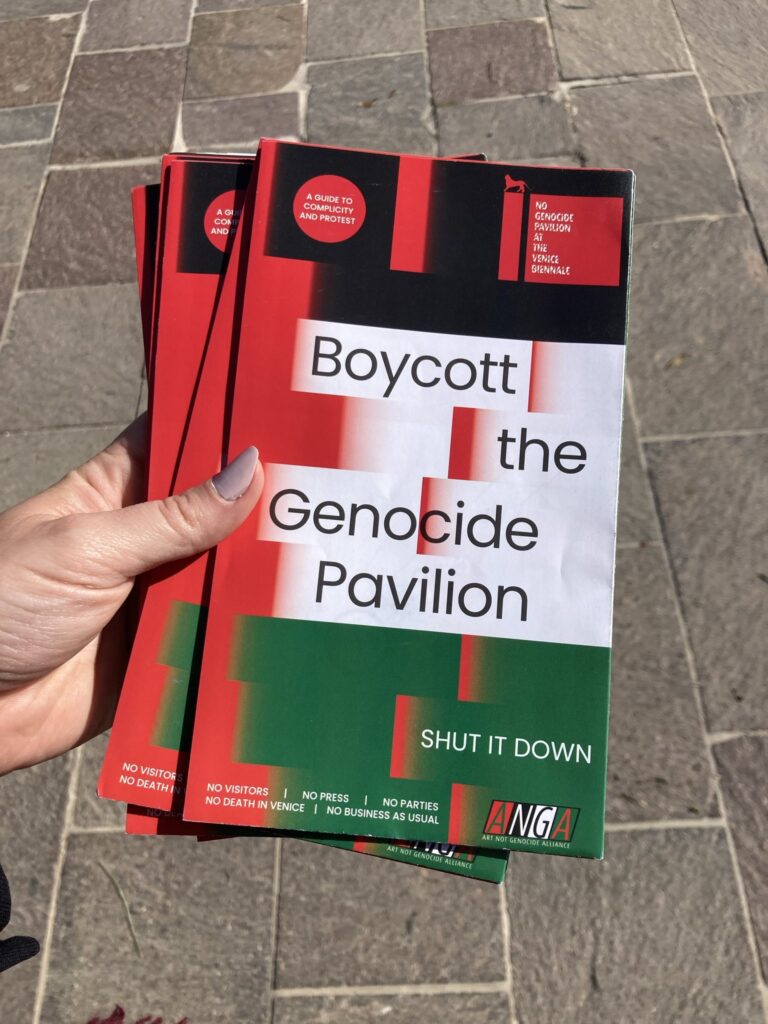
Art Not Genocide Alliance, Palestinian Art in the Streets. Photo by Art Not Genocide Alliance
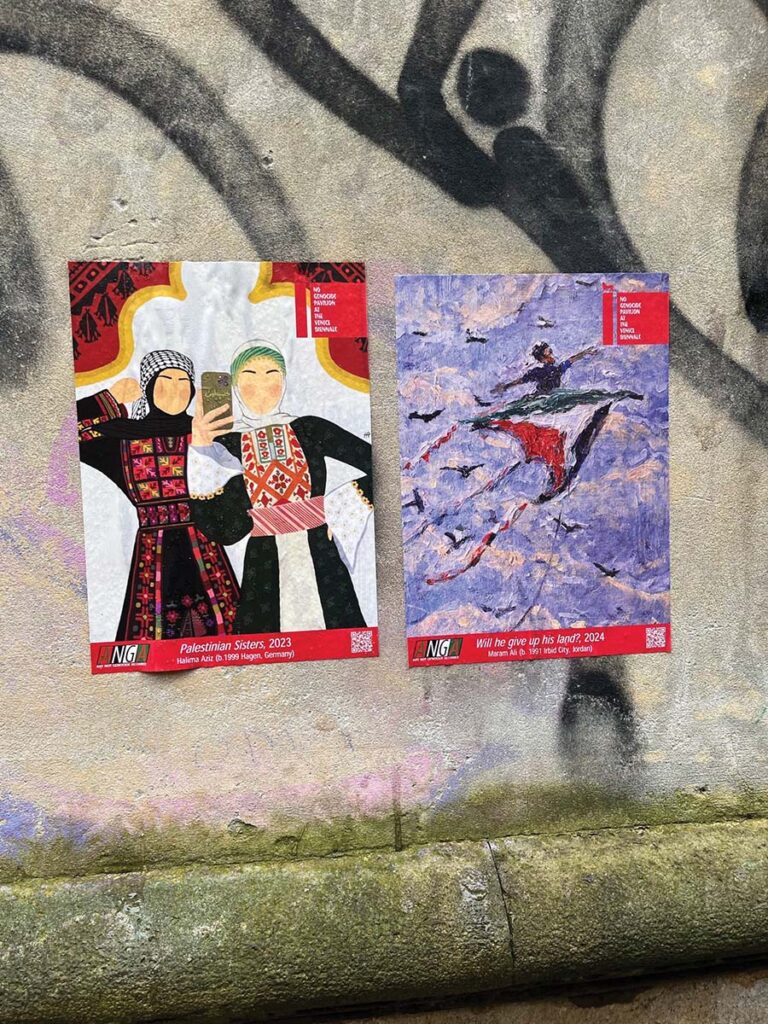
Art Not Genocide Alliance, Palestinian Art in the Streets. Photo by Art Not Genocide Alliance
The Art Not Genocide Alliance (ANGA), which has collected signatures from 197 participating artists this year through the hard work of artists and curators, has announced a “No Genocide Pavilion.” Performative protests are expected, condemning the Biennale’s allowance of Israel’s participation.
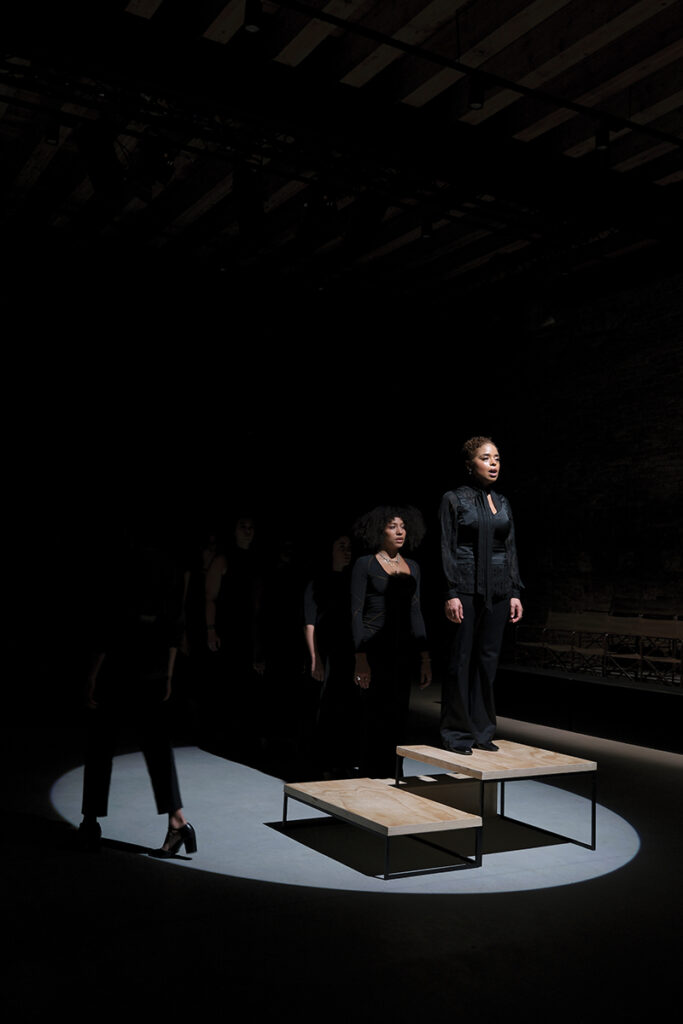
The South African Pavilion will remain empty after the controversial censorship of Gabriel Goliath’s work, which related to the ongoing genocide and was deemed too political by the Minister of Culture – despite South Africa being one of the first countries to table charges against the Israeli state for crimes against humanity. Goliath’s work, an ongoing performance called Elegy relating to the systemic elimination of groups of people including women in Africa, was then invited to show at Chiesa di Sant’Antonin.
I was present when Malta had its first permanent presence at La Biennale in 2017, and it is always a replay of that feeling to experience new countries taking up a pavilion for the first time. The Democratic Republic of Congo is debuting with Simba Moto! (Seize the Fire!) at Scuola Grande di San Marco.
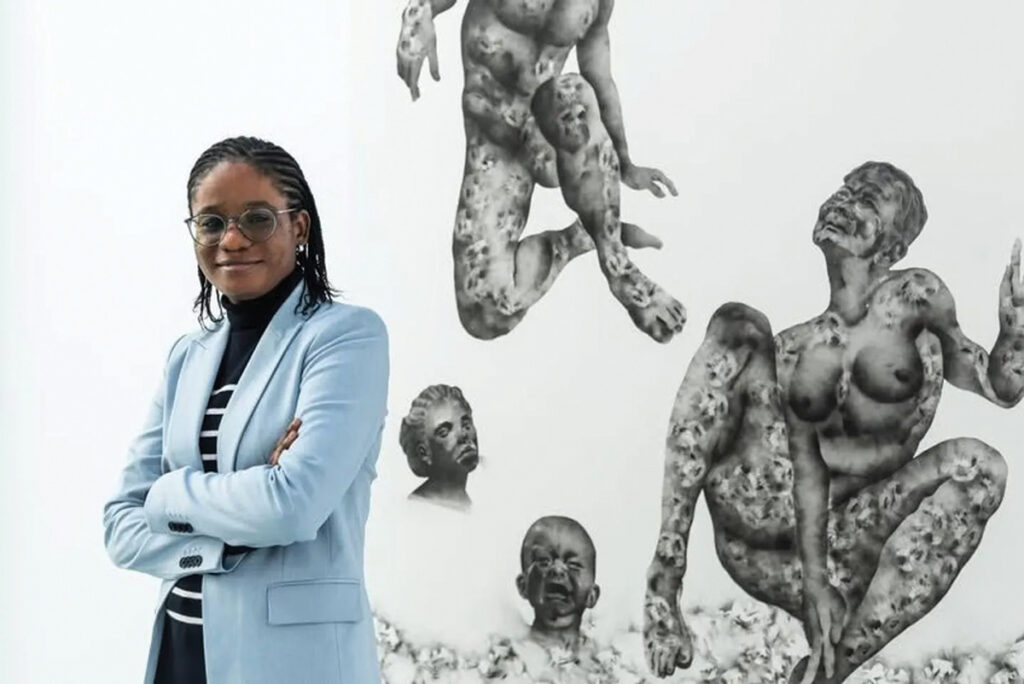
Image from: www.artrabbit.com/events/congo-pavilion-2026-simba-moto-seize-the-fire
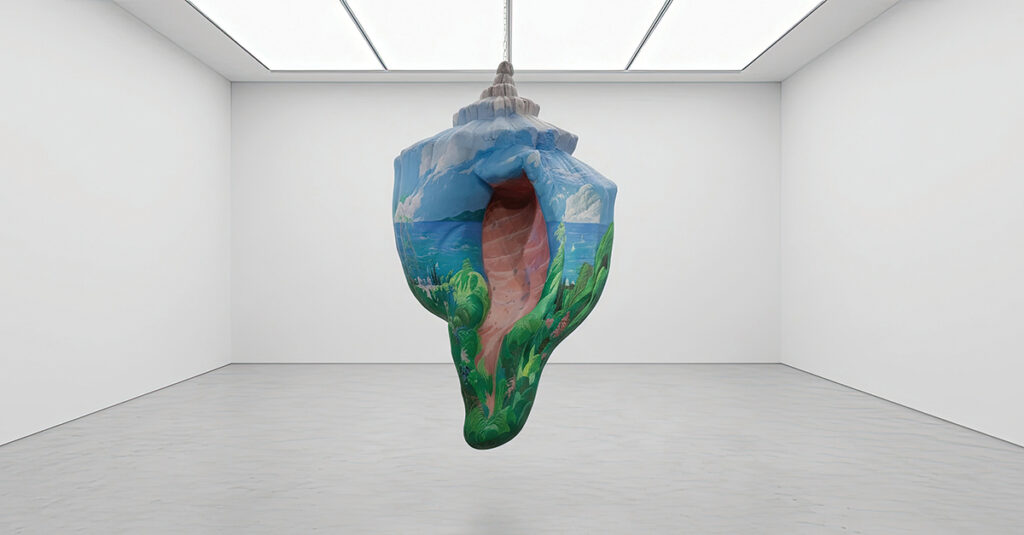
Another intriguing addition is the first Nauru National Pavilion. I caught up with one of the participating artists, Stefano Cagol, who was recently in Malta for the Malta Biennale, for his thoughts:
“The Pavilion of the Republic of Nauru at the 2026 Venice Biennale exceeds the boundaries of an island: it engages with a global condition. Nauru, participating for the first time, is not only a new presence: it is a manifestation of what is missing, what is being lost. In this sense, it fully embodies the tension between the new and the absent.
In my work, We Are All Nauru, I seek resonance against distance: what happens on that island inevitably concerns the entire world. Nauru becomes a point of condensation, where extractivism, climate crisis, and vulnerability emerge as shared conditions.
My perspective unfolds within this ambiguous space: between appearance and disappearance, responsibility and denial. Far from representing a place, I recognise a condition that pervades all of us. The video work I present is a round-the-world.In an art system that continues to produce new presences, this pavilion also works through absence, erosion, and limit. It is here, for me, that a critical space opens: where the new cannot be separated from what is no longer there.”
– Stefano Cagol, Nauru Pavilion participating artist.